
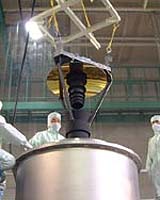
JAXA announced September 2 that the ASTRO-F telescope had passed its cryogenic vibration test. This is a very difficult test for high precision optical equipment such as telescopes, as the telescope is subjected to the equivalent vibration as that at liftoff, under cryogenic conditions.
The test was regarded as a critical point in the final verification test phase because an anomaly was found in the same test last year (damage to the support of the reflector) and that resulted in the re-manufacturing of the reflector.
The test was held between June 28 and July 1, 2004 at the Sagamihara Campus (ISAS). When the temperature of the telescope returned to normal after the cryogenic and harsh vibration conditions, it underwent post test inspections- namely a surface inspection, and an inspection for cracks at the pad connection part using ultrasonic waves.
The telescope passed the test as no problems were found during the inspections. In order to further review its optical performance under cryogenic conditions, JAXA is acquiring detailed data about a focal position and other aspects by cooling the telescope down to the absolute temperature of 9 degrees (minus 264 degrees Celsius).
JAXA also carried out the final performance evaluation test for two sets of observation equipment (FIS and IRC) for a far-infrared ray and a near- to mid-infrared ray during the three cooling cycles between early June and the end of July.
It reported some small difficulties when changing a module (MIR-S, mid-infrared camera system) after an anomaly had been found in it during the test, but the observation equipment is now in a satisfactory condition.
Along with the telescope, JAXA is currently installing two sets of equipment into the cryostat, which maintains the cryogenic temperature.
