
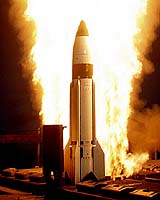
Raytheon announced Thursday that it would work with Alliant Techsystems in building an engine for the short range Stunner Interceptor. Raytheon said it would work with Allied Techsystems, or ATK, "to develop the booster motor for the flexible, affordable and lethal Stunner Interceptor, an element of the Short Range Missile Defense (SRMD) program."
"ATK Tactical Systems' composite booster motor solution for the Stunner Interceptor supports our strategy of disruptive innovation in the terminal missile defense mission area," said Michael Booen, Raytheon vice president of Advanced Missile Defense and Directed Energy Weapons programs.
"Israel and the U.S. have a critical and immediate need for an affordable, highly effective short-range missile defense capability," said Jim Condon, vice president and general manager, ATK Tactical Systems Division. "We look forward to working with Raytheon and Rafael to develop the booster motor for the Stunner Interceptor."
As previously reported in United Press International's BMD Watch, Raytheon and Israel's Rafael Armament Development Authority in May won a contract from the U.S. Missile Defense Agency and the Israel Missile Defense Organization to develop an SRMD interceptor. The Stunner Interceptor is to be the outcome of that joint U.S.-Israeli program.
"The joint program aims to develop a common interceptor solution to defeat the proliferating threat of short-range ballistic missiles and rockets. Such threats are cheap, plentiful, easily concealed and largely exempt from international arms control accords," Raytheon said in its statement.
Raytheon said ATK would develop the Stunner's booster engine at its plants in Rocket City, W.Va., and Iuka, Miss.
-0-
Kremlin can counter U.S. BMD systems — claim
Russia can deploy what it calls "effective technological solutions" to sharply reduce the effectiveness of U.S. ballistic missile defense systems that may be deployed in Central Europe, a Russian deputy defense minister warned earlier this month.
"Measures are being taken that will help parry U.S. efforts to deploy a BMD system. I cannot go into detail, but what I mean is — let me say — an asymmetric response. It involves quite simple but effective technological solutions we formulated a long time ago," Russian Deputy Defense Minister Gen. Alexei Moskovsky told the Interfax-AVN news agency Nov. 3.
Moskovsky's comments were the latest in a series of warnings that senior Russian defense officials and serving generals have been giving over the past two months in reaction to the growing willingness of the NATO alliance and of Poland and the Czech Republic, two former Soviet satellite nations that are now NATO member states, to allow U.S. forces to deploy ballistic missile defense systems in their countries in order to defend European nations from the possible future threat of Iranian nuclear-armed missiles.
In an article published in the Moscow newspaper Izvestiya on Oct. 17, Yevgeny Buzhinsky, the head of the Russian Defense Ministry's international military cooperation department, wrote that Russia would interpret the deployment of U.S. anti-ballistic missile units "near the Russian borders" as "a real threat to our deterrent forces," the Russian Strategic Rocket Forces.
"We would view that as an unfriendly gesture on behalf of the United States, some eastern European nations and NATO as a whole," he wrote. "Such actions would require taking adequate retaliatory measures of military and political character."
