
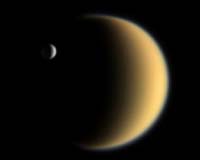
Many moons in the Saturnian system wear a uniformly gray mantle of darkened ice, but not these two. The brightest body in the solar system, Enceladus, is contrasted here against Titan's smoggy, golden murk.
Ironic, but what these two moons hold in common gives rise to their stark contrasting colors. Both bodies are, to varying degrees, geologically active.
For Enceladus, its southern polar vents emit a spray of icy particles that coats the small moon, giving it a clean, white veneer.
On Titan, yet undefined processes are supplying the atmosphere with methane and other chemicals that are broken down by sunlight.
These chemicals are creating the thick yellow-orange haze that is spread through the atmosphere and, over geologic time, falls and coats the surface.
The thin, bluish haze along Titan's limb is caused when sunlight is scattered by haze particles roughly the same size as the wavelength of blue light, or around 400 nanometers.
NASA's Cassini spacecraft took images using red, green and blue spectral filters and combined them to create this natural color view. The images were obtained on Feb. 5 using Cassini's narrow-angle camera at a distance of 4.1 million kilometers (2.5 million miles) from Enceladus and 5.3 million kilometers (3.3 miles) from Titan.
Resolution in the original images was 25 kilometers (16 miles) per pixel on Enceladus and 32 kilometers (20 miles) per pixel on Titan. The view has been magnified by a factor of two.
