
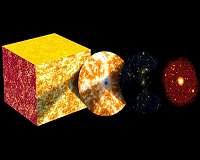
With current telescopes, scientists can observe our Universe's galaxies and galaxy clusters and their distribution along an invisible cosmic web.
From the exact measurement of the cosmic microwave background (CMB) with the Planck space observatory and many other measurements for example with the Hubble space telescope, the scientists were able to develop a precise model of our Universe. However, little is yet known about how these structures could form from the distribution of matter in the early universe.
In order to answer this question, theoretical astrophysicists work with cosmological, hydrodynamical simulations. They test their hypotheses about the universe by developing mathematical models that describe the underlying complex physical processes and run them on high-performance computers trying to reproduce the evolution of the Universe over billions of years. If the underlying assumptions are correct, the simulations should match the current astronomical observations and findings.
A group of astrophysicists led by Dr. Klaus Dolag from the Excellence Cluster Universe at the Ludwig-Maximilians-Universitat Munich in close collaboration with the LRZ have now initiated "Cosmowebportal".
This unique data centre for cosmological simulations provides access to the results of the world's most extensive set of cosmological hydrodynamic simulations, Magneticum Pathfinder, also developed by Klaus Dolag's team and carried out at the LRZ.
The complete simulations are saved at the LRZ in Garching on a data store for large datasets, which is connected to the supercomputer SuperMUC.
Using a web interface, interested scientists can, for example, select objects from the raw simulation data, process it, and even create virtual observations mimicing existing or future space telescopes.
"Large astronomical projects such as the space telescopes Euclid or eRosita, which are to be launched in the next few years, will observe large areas of the Universe, as well as provide further insight into the evolution of the first structures of the Universe so that the significance of cosmological hydrodynamic simulations will even increase in future," says Klaus Dolag.
"A data centre that pools and makes these simulations available therefore is an important facility for scientists working in the field."
Galaxy alignments traced back 10 billion years
A new study led by Michael West of Lowell Observatory and Roberto De Propris of the University of Turku, Finland, reveals that the most massive galaxies in the universe have been aligned with their surroundings for at least ten billion years. This discovery shows that galaxies, like people, are influenced by their environment from a young age.
Astronomers have long known that galaxies clus … read more
