
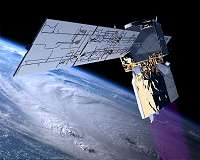
ESA's Aeolus wind satellite is poised for liftoff from Europe's Spaceport in Kourou, French Guiana. This latest Earth Explorer satellite has been at the launch site since early July being readied for its ride into space on 21 August at 21:20 GMT (23:20 CEST).
Aeolus was sealed from view in its Vega rocket fairing last week, after which it was rolled out to the launch pad, hoisted into the launch tower and joined to the rest of the rocket.
Like all of ESA's Earth Explorer missions, Aeolus will fill a gap in our knowledge of how our planet works and show how novel technology can be used to observe Earth from space.
Aeolus carries one of the most sophisticated instruments ever to be put into orbit.
The first of its kind, the Aladin instrument includes revolutionary laser technology to generate pulses of ultraviolet light that are beamed down into the atmosphere to profile the world's winds – a completely new approach to measuring the wind from space.
This technology has been particularly challenging to develop and consequently it has taken some years to get this far.
ESA's Director of Earth Observation Programmes, Josef Aschbacher, said, "Aeolus has certainly posed some technical challenges, but after all it is completely new – the wind has never been measured from space this way before.
"Aeolus is set to be a game changer for understanding the dynamics of our atmosphere and it will have real-world applications by being used to improve our weather forecasts.
