
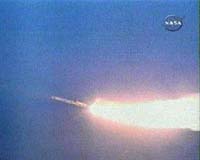
AeroAstro is celebrating NASA's successful launch on March 22 of its Space Technology 5 (ST5) satellites. Each of the three birthday-cake-sized microsatellites is equipped with an AeroAstro-built X-band transponder that provides telemetry, tracking (Doppler), and command communications that are critical to mission success.
Within four hours after launch, all three transponders on the three spacecraft were confirmed to be operating nominally and supporting checkout functions.
"We are proud to make this contribution to NASA's ST5 mission. Our history of reliable, yet inexpensive spacecraft radios dates back to ones we built for the company's first spacecraft, ALEXIS.
In April 2005, almost exactly 12 years after its launch, ALEXIS was decommissioned. Built for a three-month mission, it actually delivered 142 months of service. The X-band radios on ST5 will provide NASA with the same reliability," said Rick Fleeter, President, AeroAstro.
The transponder core measures only about 4.9" x 3.1" x 2.7"; while the accompanying 2W HPA measures only about 1.5" x 4.5" x 3.0". Together, they have a combined mass of less than 1.4 kilograms. The small size was achieved through selective use of up-screened "cell-phone" type components for maximum performance.
This full-duplex coherent DSN compatible transponder can transmit BPSK at a date rate of up to 10 Mbps and receive Bi-phase BPSK at a rate of up to 50 kbps, with a power consumption of only 4W for receive, and 20W on transmit. The system operates using 7V to 9V, making it suitable for use in the low bus voltage systems typically used in today's growing micro- and nanosatellite market
