
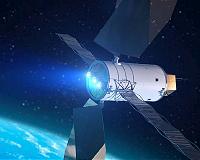
Aerojet Rocketdyne, the nation's premiere propulsion provider and a subsidiary of Aerojet Rocketdyne Holdings, Inc. (NYSE:AJRD), advocates Solar Electric Propulsion (SEP) as a central element of America's deep space architecture.
During testimony before the Subcommittee on Space in the U.S. House of Representatives, Joe Cassady, executive director for Space Programs at Aerojet Rocketdyne, said, "SEP is key to a sustainable architecture by enabling efficient transfer of cargo, habitats and payloads to deep space destinations in advance of astronaut arrival."
SEP systems have between 6 and 10 times the propellant efficiency (specific impulse) of traditional chemical propulsion systems. More than 200 commercial, civil, national security and defense spacecraft are currently flying SEP for stationkeeping, repositioning and orbit-raising.
Aerojet Rocketdyne is currently working on three separate high-power electric propulsion systems for NASA: NEXT-C xenon ion engine for planetary missions; Advanced Electric Propulsion System (AEPS) for deep space cargo missions; and NASA's NextSTEP 100kW Nested Hall Thruster for future technology insertion.
Cassady emphasized the need to take advantage of strategic logistics planning in the journey to Mars. He used the analogy of military deployment to the SEP approach for Mars cargo, saying, "Heavy equipment, supplies, and other logistical items are pre-deployed by large cargo ships and planes to the region. Then, once the equipment, barracks, etcetera are ready, the troops follow by faster air transport. SEP systems are equivalent to cargo ships for deep space missions."
Approximately 75 percent of the mass required for human missions to Mars can be transported using SEP, thereby reducing the number of launches required. Additionally, the SEP systems under development now by NASA and Aerojet Rocketdyne can reduce the amount of propellant needed for deep space missions by a factor of 10.
"As NASA looks to expand human presence in the solar system, starting with missions to lunar orbit and onto Mars, development of efficient in-space transportation systems is critical," added Cassady.
"We are well on our way to having efficient in-space transportation with SEP. We must continue to adequately fund these development efforts to ensure that we will have the first human footprints on Mars in the 2030s."
Boosting Europe's all-electric satellites
ESA astronaut Tim Peake this week opened a UK facility that will expand Europe's capability with satellites that rely wholly on electric propulsion. Sited in Belfast, Northern Ireland, it builds on the advanced manufacturing skills there. Propellant tanks, electric thrusters and steering mechanisms with the interconnecting harness and fuel lines will be assembled and installed on the satellite s … read more
