
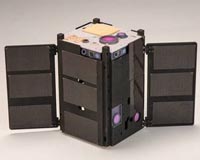
Two innovative 1.5-unit CubeSats designed and built by The Aerospace Corporation (Aerospace) were successfully launched today from NASA's Wallops Flight Facility in Va. aboard Orbital ATK's Cygnus spacecraft.
Both CubeSats were developed for NASA Ames Research Center's second Optical Communications and Sensor Demonstration (OCSD) mission. This mission focuses on two significant capabilities of value for future small spacecraft missions: high-speed optical transmission of data and proximity operations between two small satellites-both capabilities not previously demonstrated in spacecraft of this size.
"Our primary mission for OCSD is to demonstrate laser communications by using a laser on the spacecraft to downlink data to our optical ground station on Mt. Wilson in California," said Richard Welle, Aerospace senior scientist and one of the principal investigators for OCSD. "This is the first CubeSat laser communications system that will demonstrate an optical downlink. This compact laser package with its potential for much higher rates proves a promising future for CubeSat-scale laser communications."
Welle notes that each spacecraft is equipped with ultra-small star trackers, critical for precision pointing of the laser communications hardware-the laser is hard-mounted to the individual CubeSat body, with the beam pointed by controlling the orientation of the entire spacecraft.
"This innovative approach, combined with expected improvements in attitude control, will eventually enable CubeSats to downlink data at rates in excess of 1 gigabit per second," said Welle. "The precision attitude control system in OCSD is expected to enable pointing to an accuracy of better than .05 degrees, supporting 200 megabits-per-second downlinks."
The second OCSD mission, proximity operations, will involve the two satellites approaching and maneuvering around one another, within a range of 200 to 2000 meters. Welle adds that the operations will involve relative position measurements using cameras, beacons, laser rangefinders, and relative maneuvering using variable drag and propulsion.
The novel propulsion system on OCSD uses water as a propellant, which is exhausted as steam. Capabilities in proximity operations will enable multiple small spacecraft to operate cooperatively during future scientific or space exploration missions.
Also included in this launch is the Cubesat Multispectral Observation System (CUMULOS), an experimental remote-sensing payload developed by Aerospace, which flies on the NASA Jet Propulsion Laboratory Integrated Solar Array and Reflectarray Antenna (ISARA) CubeSat mission.
CUMULOS is a compact, 3-camera system that will study the utility of passively cooled commercial infrared cameras for weather and environmental monitoring missions. CUMULOS is composed of a visible wavelength camera, a short-wavelength infrared camera, and a long-wavelength infrared, microbolometer camera.
Spaceflight Awarded First NASA Contract for Launch of U-Class Payloads
Spaceflight has announced it was awarded its first NASA Kennedy Space Center Contract (KSC) for launch and integration services. The multi-year contract covers launch services in 2018 for a maximum of 24 payloads, with options to provide launch services for up to 24 additional payloads in 2019 and 2020. The potential total contract value is more than $5 million.
U-Class payloads are miniat … read more
