
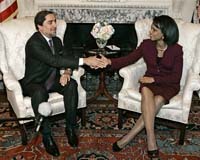
Afghan Foreign Minister Abdullah Abdullah says the security situation in his country is improving but he does not want to "give the impression of mission accomplished."
Speaking at the conservative Heritage Foundation in Washington before meeting with Secretary of State Condoleezza Rice, Abdullah Monday praised the Afghanistan Compact produced at the London Conference on Afghanistan this past February.
"There had been a worry in the backs of the minds of the Afghan people that the West would disengage once again and leave us," said Abdullah, referring to the time after the Soviets withdrew from Afghanistan in the late 1980s and the United States no longer provided aid for the shattered country. After the London Conference, he said, it was "evident that this was no longer the case." Representatives from 60 countries and the United Nations renewed their commitment to the rebuilding of Afghanistan at that meeting.
"A stable Afghanistan, an independent Afghanistan can contribute to the further betterment of the security situation," said Abdullah while discussing the threat of terrorism. "The dimensions, implications and repercussions go beyond Afghanistan or the region. It is an issue of global importance."
Abdullah called on Pakistan to honor the "good policy choice" it made after the Sept. 11 attacks, to switch support from the Taliban to the United States. He said that terrorist camps based in Pakistan are not only involved in local activities but are also involved in "sending foreign fighters into Afghanistan."
"We don't make a distinction between foreign al-Qaida and Taliban terrorist activity," Abdullah said.
The Foreign Minister said that there would be no "single solution" to the problem of illegal poppy growing in Afghanistan. "In some cases it will be rural development," he said. "In other cases, it will depend on new ideas such as growing saffron in some parts of the country."
Abdullah said that Afghanistan would be willing to work with Russia to cut down the flow of drug sales and that, "in the area of narcotic trafficking, regional cooperation is key."
Abdullah declined to comment in detail on the case of the Afghan man who faces the death penalty for converting from Islam to Christianity. He did note that the case is legal under the Afghan constitution.
The Middle East Times has recently quoted an anonymous Afghan official as saying that Abdullah may lose his position in an upcoming Cabinet shuffle planned by President Hamid Karzai.
