
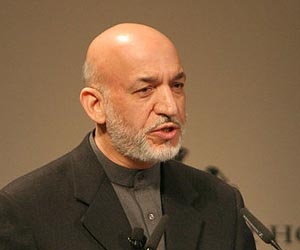
The government of Afghan President Hamid Karzai commands support or sympathy in only a quarter of 121 Afghan areas considered "key" by the US military, a Pentagon report said Wednesday.
"The overall assessment indicates that the population sympathizes with or supports the Afghan government in 24 percent (29 of 121) of all Key Terrain and Area of Interest districts," the quarterly report to Congress said.
"The establishment of effective governance is a critical enabler for improving development and security."
Karzai has gone from a darling of the international powers who placed him at the head of the Afghan state in 2001 to facing accusations from the United States and other nations that he has allowed unchecked corruption.
Popular anger at Karzai's government, which is widely seen as corrupt and inefficient, has allowed the Taliban to "perceive 2009 as their most successful year," the Pentagon report said.
"Expanded violence is viewed as an insurgent victory, and insurgents perceive low voter turnout and reports of fraud during the past presidential election (in August 2009) as further signs of their success," the 150-page report said.
According to the Pentagon, "violence is sharply above the seasonal average for the previous year — an 87 percent increase from February 2009 to March 2010."
"Although the overall security situation has stabilized somewhat since the end of 2009, violence during the current reporting period is still double that for the same period in 2008-2009," the report said.
The Pentagon said increased action by coalition forces in the country meant the Taliban has "been under unprecedented pressure."
"Reporting indicates increased and often strained efforts to resource the fight, which has led to tension and sporadic dips in morale," the report said.
It added that the decline in stability seen in the last report submitted to Congress "has leveled off in many areas over the last three months of this reporting period."
"Polls consistently illustrate that Afghans see security as improved from a year ago," the report added.
earlier related report
Canadian government pressed on Afghan war documents
Ottawa (AFP) April 27, 2010 –
Canada's government may be held in contempt of Parliament if it does not soon release uncensored documents pertaining to transfers of detainees to Afghan custody, the House speaker ruled Tuesday.
Speaker of the House Peter Milliken gave the Conservative minority government and opposition parties two weeks' time to resolve the impasse.
Otherwise, Milliken said he would return with a decision to hold the government in contempt of Parliament, which may provoke snap elections.
The Commons passed a motion in December ordering the government to produce uncensored documents it was believed might contain evidence that Canada transferred prisoners to Afghan custody knowing they may be tortured, in violation of Canadian and international law.
But Prime Minister Stephen Harper's Tory government refused to comply with the order, citing national security concerns, and instead produced tens of thousands of heavily redacted pages.
"It is the view of the chair that accepting an unconditional authority of the executive to censor the information provided to Parliament would, in fact, jeopardize the very separation of powers that is purported to lie at the heart of our parliamentary system and the independence of its constituent parts," Milliken said.
"Therefore, the chair must conclude that it is perfectly within the existing privileges of the House to order production of the documents in question."
Opposition parties applauded Milliken's pronouncement, while Justice Minister Rob Nicholson said outside the House afterwards that the government would seek a workable solution.
"We welcome the possibility of a compromise," Nicholson told reporters, adding: "Our government will not compromise Canada's national security nor will it jeopardize the lives of our men and women in uniform."
In a statement, opposition Liberal MP Bob Rae said: "We believe that it is possible to satisfy the opposition's demands for openness and transparency on the detainee scandal while maintaining national security."
The government may view the precedent-setting ruling as a sign of no-confidence in the government and call for elections, or alternatively refer the matter to the Supreme Court of Canada.
"It is no exaggeration to say that it is a rare event for the speaker to be seized of a matter as complex and as heavy with consequence as the matter before us now," Milliken commented.
In view of the "grave circumstances of the current impasse," he urged lawmakers to make one last effort to resolve the "thorny question" at hand.
Milliken encouraged both sides "to put in place a mechanism by which these documents could be made available to the House without compromising the security and confidentiality of the information they contain."
But if in two weeks' time, the matter remained unresolved, the speaker said he would rule that "the government's failure to comply with the order… constitutes prima facie a question of privilege," he said.
Share This Article With Planet Earth
