
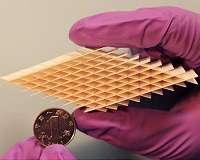
Despite the many advances in portable electronic devices, one thing remains constant: the need to plug them into a wall socket to recharge. Now researchers, reporting in the journal ACS Nano, have developed a light-weight, paper-based device inspired by the Chinese and Japanese arts of paper-cutting that can harvest and store energy from body movements.
Portable electronic devices, such as watches, hearing aids and heart monitors, often require only a little energy. They usually get that power from conventional rechargeable batteries. But Zhong Lin Wang, Chenguo Hu and colleagues wanted to see if they could untether our small energy needs from the wall socket by harvesting energy from a user's body movements.
Wang and others have been working on this approach in recent years, creating triboelectric nanogenerators (TENGs) that can harness the mechanical energy all around us, such as that created by our footsteps, and then use it to power portable electronics. But most TENG devices take several hours to charge small electronics, such as a sensor, and they're made of acrylic, which is heavy.
So the researchers turned to an ultra-light, rhombic paper-cut design a few inches long and covered it with different materials to turn it into a power unit. The four outer sides, made of gold- and graphite-coated sand paper, comprised the device's energy-storing supercapacitor element.
The inner surfaces, made of paper and coated in gold and a fluorinated ethylene propylene film, comprised the TENG energy harvester. Pressing and releasing it over just a few minutes charged the device to 1 volt, which was enough to power a remote control, temperature sensor or a watch.
How does oxygen get into a fuel cell
Fuel cells use a simple chemical reaction, such as the combination of oxygen and hydrogen to form water, to generate electricity. The question of which is the best material to use when making ceramic fuel cells is not a straightforward one, however. New materials are required that act as a catalyst for the chemical reaction required with maximum efficiency, but that also last as long as possible … read more
