
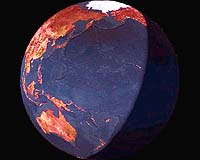
Now that the discovery of extrasolar planets, or planets around distant stars, has become relatively routine, scientists are now tackling the next step: finding life-bearing worlds. To do this, observers must know what signs to look for in the feeble light from these faraway planets.
Astronomers at the Harvard-Smithsonian Center for Astrophysics (CfA), in collaboration with researchers at the University of Arizona's Steward Observatory, have identified key signatures of life by studying Earthshine-the light of the Earth reflected off the dark side of the Moon.
They found clear signs of water and an oxygen atmosphere, as well as tentative signs of plant life. Their findings give a clear indication of what "fingerprints" to search for when seeking life on Earth-like worlds orbiting distant stars.
"Our research is paving the way for future missions like the Terrestrial Planet Finder," says Smithsonian astronomer Wes Traub. "Hopefully, within the next 10 years astronomers will be able to confidently say that some as-yet-undiscovered planet is a living world like our own."
Archetypal Earth
So far, astronomers can only detect Jupiter-like planets around other stars because such planets are large and create strong gravitational signals. However, as technology continues to improve, astronomers soon will be able to locate Earth-like extrasolar planets and study their dim light to search for signs of life. To know what to look for, they must use the example of the one planet where life is known to exist: the Earth.
To replicate the view that a distant astronomer would have if studying the Earth from another planet, Traub and his colleagues used the nearby Moon as a mirror. Using the Steward Observatory 90-inch telescope at Kitt Peak, Arizona, they measured both the light of Earthshine from the Moon and the light of the Moon itself, then corrected the Earthshine to determine how the Earth would appear to a faraway observer. They compared this measured spectrum to a model created by Traub and CfA's Ken Jucks.
The team found that Earthlight shows strong evidence for water – a necessary ingredient for life as we know it – and for molecular oxygen, which must be continually replenished by the processes of life to remain in the atmosphere. They also found features that suggested the presence of chlorophyll, indicating the existence of land plants.
The latter showed up as bright reflections in the far-red region of the visible spectrum. This "red edge" is a well-known signature of chlorophyll, which appears green to us only because our eyes aren't very sensitive at the red end of the visible spectrum.
The team also suggests that changes for finding life-bearing worlds are improved because the signatures can develop early in a planet's history and last for a long time. Our home planet has maintained an oxygen atmosphere for the past two billion years, and has shown a "red edge" since the first land plants evolved 500 million years ago.
"If someone out there is watching our solar system," Traub points out, "they could have detected plant life here long before any intelligent life appeared."
Findings Match Galileo
