
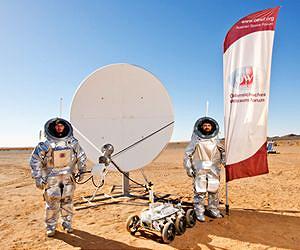
Mars 2013 analog field simulation, held by the Austrian Space Forum in Morocco this February is over, and now the organizers have published the full report from the mission.
The project's goals, involving over 100 participants from 23 countries, were to conduct a series of experiments in conditions most accurately resembling environment on Mars.
Conducting field research in a representative environment was an excellent tool to gain operational experience and understand the advantages and limitations of remote science operations on other planetary bodies.
The area near Erfoud is considered as a relevant proxy for various types of geological features of Mars, as well as a diversity of paleo(micro)biological signatures, terrain topographies similar to the Martian deserts and a test site area size which requires a diligent exploration mission design. This field mission was designed to be:
+ an opportunity to study equipment behavior involving the simultaneous usage of instruments with the option of a human-in-the-loop (via the Aouda.X spacesuit),
+ a platform for testing life-detection or geophysical techniques, performing terrain tests for rovers and test concepts for high situational awareness of remote support teams,
+ studying the northern Sahara as a model region for Martian deserts and extreme life,
+ serving as an outreach platform to enhance the visibility of planetary sciences
The satellite internet provider for the project was BusinessCom Networks, in association with teleport partner Constellation Networks Corp., and Oasis Networks providing field support.
Connectivity between field operations and Mission Support Center in Austria and locations in Poland and Hungary was essential for MARS 2013 experiments. The 10-minute latency was implemented on the satellite link in order to simulate real life conditions during a planned manned expedition to Mars.
