
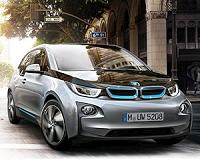
BMW Group announced Wednesday it would deploy 40 self-driving vehicles for tests in the United States and Europe
The German auto group made the announcement at the Consumer Electronics Show in Las Vegas jointly with US computer chip giant Intel and the Israeli-based auto technology firm Mobileye.
"Making autonomous driving a reality for our customers is the shared ambition behind our cooperation with Intel and Mobileye," said BMW board member Klaus Froehlich in a statement, who said the tests would be a major step toward achieving a fully autonomous vehicle by 2021.
"This partnership has all of the skills and talent necessary to overcome the enormous technological challenges ahead and commercialize self-driving vehicles. Therefore, we are already thinking in terms of scalability and welcome other companies — manufacturers, suppliers or technology companies – to participate and contribute to our autonomous platform."
The companies said they plan to begin testing by the end of this year, joining autonomous vehicles from Google's Waymo, Uber and others being used in real-traffic situations.
BMW Group will be responsible for driving control, safety and the production of the car platform.
Intel will offer its Intel Go computing platform that uses a variety of sensors and other data to power the brains of the car.
Mobileye will be using its proprietary EyeQ5 computer vision processor which gets input from the 360-degree surround view sensors as well as localization.
"From an industry perspective, we are already seeing savings and speed in development by sharing development costs and in pooling resources to develop a complete autonomous platform," Intel chief executive Brian Krzanich said.
"That's why this partnership is breaking new ground. We have established a dedicated team with clear, shared goals and a culture of innovation and agility and accountability."
Nearly all the major global automakers are involved in testing or autonomous or semi-autonomous vehicles, with some expecting full autonomy within a few years.
Hyundai eyes autonomous cars for the masses
Las Vegas (AFP) Jan 5, 2017 – Hyundai's Ioniq draws little attention as it maneuvers the streets of Las Vegas.
The mid-sized sedan is one of a number of autonomous cars roaming the city's streets during the high-tech Consumer Electronics.
The South Korean automaker wants to stand out by being ordinary: making a self-driving car for the average consumer.
"The autonomous Ioniq concept is a normal car, not a science project," said Mike O'Brien, vice president of Hyundai North America, during a demonstration for AFP.
"We believe in democratizing this technology."
Hyundai's unremarkable car stands in contrast to others being shown at the huge tech show, which include a number of pricey models with more horsepower and luxury features.
Many automakers are planning for autonomous vehicles but O'Brien says Hyundai "can deliver at an affordable price point" for the average consumer.
In the demonstration, the Ioniq was able to use its turn signal, change lanes, stop at a red light and yield to pedestrians.
In one instance, it began to accelerate with a green light but then suddenly braked.
Vehicle technology manager Andre Ravinowich said the sudden shift came because "the car in front started moving, but braked" and the Ioniq acted to avoid getting too close.
Engineers are working to refine the algorithms which govern these kinds of decisions, based on data collected from sensors in the car and other information.
Hyundai and other automakers are using a technology called LIDAR, or light detection and ranging, for remote sensing of vehicles, pedestrians and other things in the environment.
Ravinowich said there are still a few hurdles before autonomous driving becomes mainstream.
"Technology-wise it's not too far away, we're closer than a lot of people think," he said.
But he said that it will also depend on government regulations and infrastructure which is compatible with the new electronics.
"A lot of regulations need to change, infrastructures need to be in place," he said.
The tests show the system is not perfect. When the Ioniq was behind an idled truck, the operator behind the wheel (as a safety precaution) had to manually use a turn signal to indicate a lane change to overtake the truck.
"It's still something we need to work on," Ravinowich said.
Hyundai has offered no date for when it would have an autonomous vehicle ready but some others have set a target for around 2020.
