
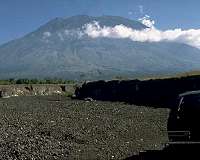
Thousands of people who were forced to evacuate their houses on the Indonesian island of Bali because of a rumbling volcano can now return home, authorities said Saturday as they lowered Mount Agung's alert level.
The volcano, located about 75 kilometres (46 miles) from the tourist hub in Kuta, has been periodically spewing molten clouds of ash and smoke for months, forcing more than 100,000 people to flee the area and prompting the closure of the island's international airport.
But on Saturday, Indonesia's volcanology centre lowered Agung's alert level from four to three, citing a decline in its activity.
"The volcanic earthquakes are now… declining significantly. The deformation is deflating and getting more stable and the concentration of the volcanic gas spewing into the air is also declining," the centre's senior volcanologist Gede Suantika told AFP.
Under the new alert level, the no-entry zone has been reduced to four kilometres from Agung's peak, an area with no residents, allowing all evacuees to return home, authorities said.
"The public activities as well as the tourism in Bali have been declared safe, there is no more disturbance from Mount Agung's activities," Indonesia's energy minister Ignasius Jonan said in a statement.
Agung rumbled back to life last September. The volcano's activity slowed down in late October, before the eruption threat reared its head again in November, sparking travel chaos and pounding Bali's lucrative tourism industry and its wider economy.
Currently nearly 20,000 evacuees are sheltering in 180 locations across the island.
The volcano's last eruption was in 1963, killing around 1,600 people.
Indonesia, the world's most active volcanic region, lies on the Pacific "Ring of Fire" where tectonic plates collide, causing frequent volcanic and seismic activities.
Japan's Kikai Caldera hosts giant lava dome, survey confirms
Washington (UPI) Feb 9, 2018 –
A trio of surveys carried out by scientists with the Kobe Ocean Bottom Exploration Center in Japan has confirmed the presence of a giant lava dome in the Kikai Caldera, a mostly submerged caldera located south of Japan's main islands.
Kikai is one of Earth's largest post-caldera volcanoes. The latest research — published Friday in the journal Science Advances — a giant lava dome has developed since the volcano's massive eruption some 7,300 years ago.
KOBEC researchers used a variety of instruments and analysis methods to study the caldera and its internal structure. Scientists combined the observations of underwater robots and the results of rock sample analysis with data collected by seismographs and electromagnetometers.
The results of the survey suggest the makeup of Kikai's lava dome is similar to the contents of the post-caldera volcano found on the nearby island of Satsuma Iwo-jima.
"It is possible that currently a giant magma buildup may exist under the Kikai Caldera," scientists wrote in a news release.
Scientists determined there is a 1 percent risk of the magma inside Kikai's lava dome erupting during the next century. If the dome were to erupt, Japan's archipelago could experience the sudden release of 40 cubic kilometers of lava.
The nature of the dome's internal plumbing isn't yet clear. In follow-up surveys, scientists plan to conduct high-resolution imaging of the dome's deep-lying inner structures using seismic and electromagnetic methods. The future surveys will give scientists a better idea of how and when the caldera and its lava dome might erupt in the future.
