
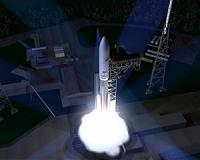
United Launch Alliance, a joint venture between Boeing and Lockheed Martin, on Monday announced plans to replace its current military space rocket models with a new design featuring a cost-cutting reusable engine.
The Vulcan rocket will take the best parts of the Atlas V and Delta IV launch vehicles but will cut costs dramatically through a recyclable first-stage booster engine known as Sensible, Modular, Autonomous Return Technology (SMART), ULA said in an online statement.
After lift-off the engine is designed to break away and deploy a heat shield when re-entering the atmosphere, slowing it down enough to be hooked mid-air and towed away by a helicopter.
ULA believes this will result in a 90 percent reduction in booster propulsion costs.
Speaking at the 31st National Space Symposium in Colorado Springs, Colo., ULA President Tory Bruno said the system will be "the highest-performing, most cost-efficient rocket on the market."
Also announced was a new second-stage engine design that would last for weeks, rather than days, in space. The Vulcan will use the current second-stage Centaur engine until 2023, when it will switch to the new design. ULA plans to field the Vulcan's recyclable engine by 2024.
Industry experts estimate the Vulcan, which is being self-funded by ULA, to cost between $2 billion and $3 billion.
ULA has been under pressure due to competition from SpaceX, which is expected to be certified for military launches by June and has also aimed to cut launch costs through attempts to land its reusable Falcon rocket system on a floating barge in the Atlantic Ocean. Two previous attempts failed and a third was cancelled Monday afternoon due to weather conditions.
