
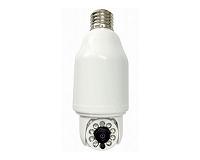
The marriage of cell phone and camera technologies has given birth to a nifty surveillance device that puts a set of eyes in nearly any room with the twist of the wrist. If it catches on, the new iBulb Scope may help to make home security a snap.
Measuring about the size of an elongated incandescent light bulb, the iBulb Scope is a HD/VGA camera that installs into a standard 100 volt, 50Hz/60Hz AC electric socket. It is "box ready" to begin transmitting photos and video of nearby objects by wi-fi to the owner's cell phone through a downloadable app.
The lens has a 330 degree meter radius, with a range of focus effective to about four meters. Light sensitivity is good down to 5.0 lux – equivalent to a clear early twilight. It also comes equipped with its own LED illumination. Camera angle adjustments are done manually.
Fukuoka-based Spec Computer developed the gadget; be-Trust, an Osaka consumer goods company, is a principle sales agent, having started a campaign in late 2015. be-Trust CEO Toshihiro Ikeda was on hand at a recent trade show in Tokyo to show off the item, and found himself besieged with inquiries.
"We originally intended the iBulb as for home use, where it could act as a monitor for pets, elderly family members and personal valuables," he says. "But ironically, 99% of the interest has come from small businesses. Convenience stores find themselves undermanned and construction companies need to set up temporary work sites where they keep equipment."
The iBulb transmits in real time to registered cell phones, and can send email alerts when motion is detected in the field of its CMOS sensor. Images can be saved to a 4GB portable micro SD memory card, which comes included. A separate 32GB card allows continuously recording for 12 straight days in 640 x 480 VGA video format.
The camera has made its way to several online retail sites, where it can be purchased for around Y24,000. Buyers are generally pleased with its portability and screw-in convenience, but have expressed some concerns about interior colors rendered in yellow tint, while outside images appear with a purple hue.
The appearance of the iBulb and on the market comes amid continuing global growth in home security gear that has accelerated with improvements in network infrastructure, increased broadband and internet penetration, and preference for wireless and techno-logically advanced gadgets.
In 2014, security cameras comprised nearly 22% of the global home security system market, and this trend is expected to continue in the next five years. The total market is expected to reach close to $48 billion by 2020, according to research site Markets and Markets.
