
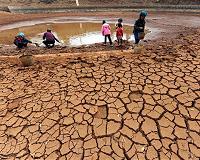
Residents of drought-stricken Cape Town received rare good news Monday when city officials said they now face losing piped water to their homes on May 11 — a month later than previously forecast.
But Capetonians are not yet out of the woods. If drastic consumption reductions are not achieved by so-called "Day Zero", people will have to queue at 200 standpipes for daily rations of 25 litres (6.6 US gallons).
The city, which attracts millions of tourists every year, has enforced strict waste controls including prosecution of homeowners who use more than the current 50-litre daily limit.
"The day we may have to start queueing for water is expected to move out to mid-May 2018 due to a decline in agricultural usage," deputy mayor Ian Neilson said in a statement.
"Capetonians must continue reducing consumption if we are to avoid 'Day Zero'. There has not been any significant decline in urban usage. All Capetonians must therefore continue to use no more than 50 litres."
Every day the city uses more than 450 million litres, so-called "Day Zero" — the last day of normal water supply — becomes more likely. In the past week, city-wide consumption stood at an average of 547 million litres daily.
The previous forecast for "Day Zero" was April 16.
The city has published a name-and-shame list of the worst water offenders in Cape Town, and it says it is issuing fines for the heaviest water users.
But officials have been criticised for failing to implement usage restrictions sooner, and accused of ignoring warnings by experts in the years before the drought.
Strong summer rains saw much of southern Africa recover from a drought induced by the El Nino weather phenomenon.
But Mediterranean-like Cape Town receives most of its rain in the southern hemisphere's winter — and scientists warn there is no guarantee of a good rainy season.
Officials in Cape Town appealed on Monday for residents to be vigilant against health risks caused by efforts to save or reuse water as the South African city's drought worsens.
The city is grappling with a listeriosis outbreak and a doubling of typhoid cases in the past year.
It has now urged residents to continue hand washing to maintain hygiene standards — despite water shortages.
"This is the season where the germs have a way of propagating and spreading," the city's health manager, Virginia De Azevedo, told a press briefing.
"We are talking faecal-oral contamination of the water, the food and the hands… In the health facilities, we are all on alert."
De Azevedo warned that hand sanitiser gels were often an inadequate substitute for hand-washing with potable water.
"You can still wash your hands without wasting water," she said.
Capetonians have been urged to use just 50 litres (13.2 US gallons) of water per day in an effort to delay the arrival of "Day Zero" when most residents will have their taps shut off.
After "Day Zero", currently forecast for April 16, many of the four million residents of South Africa's second city will be forced to queue at some 200 standpipes for a daily allocation of 25 litres.
Health officials also warned that residents could be putting themselves at danger by trying to purify dirty water, not boiling natural spring water before consumption and using untested boreholes.
"If they are taking water from the springs they must boil it or use purification tablets," said De Azevedo.
"The public must be aware of what are the water sources that are safe."
"We are aware that cholera is a very big threat and that typhoid is a very big threat," she added, referring to other parts of the words that have also suffered chronic water shortages.
