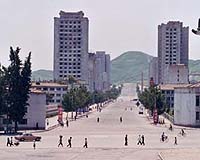
When North Korea opened the border city of Kaesong to South Korean manufacturers in 2003, skepticism was high about the future of the first-ever inter-Korean industrial park. The idea was simple: joining South Korean capital and technology with cheap North Korean labor. But its implementation did not seem easy, given the cautionary history of South Korean business ventures in the communist neighbor for the past decades because of the high geopolitical risks.
Some critics said the project could be held hostage by the communist state in the political standoff with its capitalist enemy.
Four years later, however, a vast field just north of the heavily armed border has been transformed into a mammoth industrial park with 16,000 acres, including residential and commercial zones. The joint industrial complex now flourishes, enduring cross-border military tensions over the North's nuclear and missile threats.
It is buzzing with North Korean workers mingling with South Korean managers. Earth-moving vehicles with the brand name of Hyundai, South Korea's conglomerate, are busy on the sprawling building site.
A total of 23 South Korean factories are now producing items such as clothes, athletic shoes, watches and cosmetic cases, hiring more than 14,000 North Korean workers, mostly women in their 20s and 30s. The products are delivered to the South for sales and exports.
The complex made a total of $115 million worth of products since January 2005, mostly textile and clothes. Four more factories are under construction to produce bags and clothes.
"I am fully satisfied with the quality of North Korean workforces here," said Park Sung-chul, president of Shinwon Co., a South Korean apparel maker that runs a factory in the Kaesong industrial complex.
"Labor productivity here is higher than that of our other overseas plants, such as China and Indonesia," Park said, adding he is considering more investment in this industrial park.
According to Hyundai Asan, a South Korean developer of the industrial complex, the number of North Koreans working in the zone is expected to reach more than 300,000 by 2020 for 2,000 factories, making $20 billion worth of products annually.
"A number of South Korean labor-intensive companies, suffering from high wages at home, want to relocate their plants to Kaesong," said Jang Whan-bin, Hyundai Asan's senior vice president for investor relations.
"We will eventually turn the industrial complex into a city with hotels, golf courses and a peace park," he said, noting his company is seeking to induce foreign investment.
Ha Myeng-keun, executive vice president of the Seoul-based Korea Federation of Textile Industries, described the complex as "the land of opportunity."
"Textile represents the most significant success of the complex, contributing to nearly half of the production of the complex," Ha said. "With the benefit of a shared language, the complex also benefits from high productivity and quality due to rapid technical training. Final costs are one-third those of China."
North Koreans also vowed best efforts to entice more companies from the South and other countries.
"The Kaesong Industrial Complex is trying to catch up with the global market standards," Choe Hyang, a 23-year-old North Korean female interpreter, told a group of Seoul-based diplomats who toured the industrial park. "I'm happy to work here, with South Koreans," said Choe, who graduated from Pyongyang University's foreign studies' English department.
"The Kaesong industrial zone should succeed for the North and the South. It will accelerate inter-Korean economic cooperation and reunification," said a North Korean government official who oversees the project. "We are ready to welcome more companies from the South," said the official, who gave only his surname, Kim.
Responding to the question on whether North Korea's nuclear program was a factor behind reluctance of business ventures in the North, the official said, "South Koreans don't need to fear (us) because our nuclear (weapons) are not aimed at the South, but at the United States."
The inter-Korean industrial project can be dramatically boosted if a cross-border railway is reconnected. Lying only 43 miles north of Seoul, Kaesong will be linked to major South Korean cities by the cross-border railway. The two Koreas conducted first trial runs of newly restored cross-border tracks earlier this month. If the railway opens to normal traffic, the South can transport goods and raw material to and from the Kaesong complex.
"That would reduce the cost of transporting goods by more than half," said Kim Dong-keun, South Korean head of the Kaesong Industrial Complex Management Committee, composed of North and South Korean officials.