
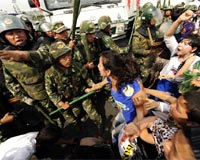
A leading Chinese artist vowed Thursday to sue police in southwest China for detaining, beating and blocking him from testifying at a trial of a fellow activist charged with subversion.
Ai Weiwei was forcefully blocked from attending the Wednesday trial of Tan Zuoren who was arrested after investigating whether shoddy construction caused school collapses in last year's massive Sichuan earthquake, he said.
"Police violently broke into our hotel room, beat us and prevented us from attending the trial," said Ai, who was released with several others after 11 hours in police custody.
"They restricted our freedom of movement and they refused to give us a reason for their actions. We want to follow up on this. We will sue," he told AFP by telephone.
Ai said he was struck in the face by a policeman after he demanded that they show their identification papers and explain why they had broken down the door to their hotel room in Chengdu, capital of Sichuan province.
Police in Chengdu declined immediate comment on the incident when contacted by AFP.
A co-designer of the Bird's Nest, the centrepiece stadium of the Beijing Olympic Games, Ai is a respected artist who has led a group of volunteers investigating the collapse of school houses in the earthquake that left over 87,000 people dead or missing.
Schools bore the brunt of the May 12 quake, with thousands collapsing on top of students, fuelling angry charges from parents that corruption had led to shoddy construction.
Tan Zuoren was tried on charges of "inciting subversion of state power" during a brief trial Wednesday that ended without verdict.
"The trial was terrible. Three witnesses were not allowed by the court to attend the trial. We believe it's against the law," Tan's lawyer Pu Zhiqianq, told AFP on Wednesday.
"Also, the video evidence we had was not allowed to be played in court and our speeches were often interrupted," he said.
"I'm not optimistic about (Tan's) fate although the verdict was not announced."
Ai is a prominent artist, architect and photographer who has become increasingly active on political issues.
Born in 1957, he is the son of late Chinese poet Ai Qing, who was persecuted during the Cultural Revolution (1966-1976), but today is revered as a leading poet.
Share This Article With Planet Earth
