
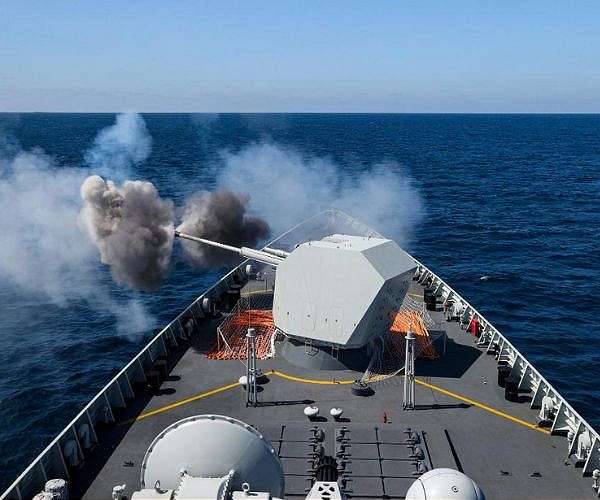
China was due to hold live-fire drills on Monday to round off three days of military exercises in response to Taiwan's president meeting with the US House speaker.
Chinese fighter jets and warships simulated strikes on the self-ruled island over the weekend in exercises that sparked condemnation from Taipei and calls for restraint from Washington.
Dubbed "Joint Sword", the three-day operation has included rehearsing an encirclement of Taiwan, the People's Liberation Army's (PLA) Eastern Theatre Command said.
China's war games involved sending planes, ships and personnel into "the maritime areas and air space" around all four sides of Taiwan, the army said of the exercises.
On Beigan island, part of Taiwan's Matsu archipelago that is within eyesight of China's mainland, 60-year-old chef Lin Ke-qiang told AFP he simply did not want war.
"We, common people, just want to live peaceful and stable lives," Lin said, adding Taiwan's military was no match for China's.
"If any war happens, now that their missiles are so advanced, there's no way our side could resist. This side will be levelled to the ground."
A report from China's state broadcaster CCTV on Sunday said drills had "simulated joint precision strikes against key targets on Taiwan island and surrounding waters", adding that forces "continued to maintain the situation of closely encircling the island".
The air force also deployed dozens of aircraft to "fly into the target airspace", and ground forces had carried out drills for "multi-target precision strikes", the report added.
Taiwanese President Tsai Ing-wen denounced the drills, which come after she met last week with US House Speaker Kevin McCarthy outside Los Angeles on her way home from a visit with two allied countries in Central America.
She pledged to work with "the US and other like-minded countries" in the face of "continued authoritarian expansionism".
In Washington, a State Department spokesperson said the United States had "consistently urged restraint and no change to the status quo", while the Pentagon said it too was "monitoring events closely".
"There is no reason for Beijing to turn this transit — which was consistent with longstanding US practice and policy — into something it is not or use it as pretext to overreact," a Defense Department spokesperson said Sunday, referring to Tsai's stop in California.
The United States has been deliberately ambiguous on whether it would defend Taiwan militarily, although for decades it has sold weapons to Taipei to help ensure its self-defence.
China and Taiwan split at the end of a civil war in 1949. China views democratic Taiwan as part of its territory and has vowed to take it one day, by force if necessary.
– Live-fire exercises –
Exercises on Monday will include live-fire drills off the rocky coast of China's Fujian province, about 80 kilometres (50 miles) south of the Matsu islands and 190 kilometres from Taipei.
The local maritime authority said the exercises would be held between 7:00am and 8:00pm around Pingtan, a southeastern island that is China's nearest point to Taiwan.
"These operations serve as a stern warning against the collusion between separatist forces seeking 'Taiwan independence' and external forces and against their provocative activities," said Shi Yin, a PLA spokesman, said about "Joint Sword".
AFP journalists on Pingtan did not see any immediate military activity in an offshore area on Monday.
A small number of fishing boats and small cargo ships were near the shore on Monday morning.
It was not possible to discern the identities of some more distant ships, and much of the cordoned-off area was not visible from the shoreline.
Taipei's defence ministry said it had detected 11 Chinese warships and 70 aircraft around Taiwan on Sunday.
It said 45 aircraft had crossed the median line separating Taiwan from mainland China on Saturday — the most incursions this year, according to figures maintained by AFP.
Over the weekend there were around 150 detections of Chinese ships or aircraft, including fighter jets, drones, bombers, and transport aircraft, according to the ministry.
In August last year, China deployed warships, missiles and fighter jets around Taiwan in its largest show of force in years following a trip to the island by McCarthy's predecessor, Nancy Pelosi.
Seven decades of China-Taiwan relations
Taipei (AFP) April 10, 2023 –
As China moves into a third day of military drills around Taiwan, AFP looks at the history of relations between the self-ruled island and Beijing:
– 1949: separation –
Mao Zedong's communists take power in Beijing in October 1949 after defeating Chiang Kai-shek's Kuomintang (KMT) nationalists in a civil war.
The KMT flee to the island of Taiwan and form their own government in Taipei in December, cutting off contacts with mainland China.
In 1950, Taiwan becomes an ally of the United States, which is at war with communist China in Korea. The United States deploys a fleet in the Taiwan Strait to protect its ally from possible attack.
– 1971: Beijing gets UN, US nods –
In October 1971, Beijing takes over China's seat at the United Nations, previously held by Taipei.
In 1979, the United States cuts formal ties with Taiwan and establishes diplomatic relations with Beijing instead.
Washington goes on to develop a nuanced Taiwan policy where it "acknowledges" China's claim to the island, which is not the same as accepting Beijing's claim of sovereignty.
The United States also maintains trade and military ties with Taipei. It opposes both Taiwanese independence and any attempt by China to forcibly take the island.
– 1987-2004: relations improve –
In late 1987, Taiwan residents are permitted to visit mainland China for the first time, allowing families to reunite.
Taiwan lifts emergency rule in 1991, unilaterally ending a state of war with China. The first direct talks between the two sides are held in Singapore two years later.
But in 1995, Beijing suspends talks in protest at a visit by Taiwanese president Lee Teng-hui to the United States.
China tests missiles off Taiwan in 1996 to deter voters in the island's first democratic presidential election.
In the 2000 elections, the KMT loses power in Taiwan for the first time. Trade links between the two sides improve over the next few years.
– 2005-2015: threats and talks –
Beijing adopts a law in March 2005 authorising the use of force if Taiwan declares independence. In April, KMT chairman Lien Chan makes a landmark visit to Beijing for talks with Chinese leader Hu Jintao.
In 2008, Taiwan and China resume high-level talks after the KMT's Ma Ying-jeou is elected president on a Beijing-friendly platform.
They sign a sweeping Economic Cooperation Framework Agreement in 2010 and in 2014 hold the first government-to-government talks since separation.
– 2016: honeymoon over –
Tsai Ing-wen, from the traditionally pro-independence Democratic Progressive Party, wins the presidential elections in January 2016.
In June, China suspends all communications with Taiwan after the new government fails to acknowledge the "One China" policy.
In December, US president-elect Donald Trump breaks with decades of US diplomatic policy by speaking directly with Tsai by telephone.
Chinese President Xi Jinping says in January 2019 that the unification of China and Taiwan is "inevitable".
– 2021: US-China tensions –
In 2021, Chinese military jets make hundreds of incursions into Taiwan's defence zone.
In October, President Joe Biden says the United States will defend Taiwan if China attacks it, in comments later partly walked back by the White House.
Tsai confirms that a small number of US troops are present in Taiwan to help train its forces.
– 2022: Pelosi visit sparks fury –
US House Speaker Nancy Pelosi lands in Taiwan on August 2 during a tour of Asia after days of speculation and stern warnings from Beijing of unspecified "consequences".
The highest-profile elected US official to visit the island in 25 years says her visit demonstrates her country's "unwavering commitment to supporting Taiwan's vibrant democracy".
A furious China vows "punishment" and launches its largest-ever military exercises in the area, encircling Taiwan on August 4 and conducting war drills that last for around a week.
The exercises include the deployment of fighter jets and warships, and the firing of ballistic missiles.
Taipei responds with drills of its own and in the following weeks, the United States sends warships through the Taiwan Strait and announces new military aid packages for the island.
China slaps sanctions on Pelosi but her visit rallies other US and European delegations to land in Taiwan.
– 2023: Tsai meets McCarthy –
Tsai makes two stops in the United States on her way to and from Latin America, meeting House Speaker Kevin McCarthy on the return leg in California on April 5.
Beijing warns against the meeting and issues several rebukes after, insisting Taiwan is part of its territory and that "China's sovereignty and territorial integrity will never be divided".
On April 8, the day after Tsai returns to Taipei, Beijing launches three days of military drills rehearsing an "encirclement" of Taiwan and simulating strikes on the island.
On Monday, China is set to conduct live-fire drills around Pingtan, a southeastern island that is China's nearest point to Taiwan.
