
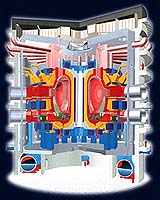
French President Jacques Chirac is to lead a signing ceremony Tuesday to develop a new breed of experimental nuclear fusion reactor that mimics the energy-producing process powering the sun, officials said. The event in Paris will see representatives from China, the European Union, India, Japan, Russia, South Korea and the United States setting pen to paper to formally set up the structure of the 10-billion-euro (12.8 billion dollar) reactor.
The facility — originally called the International Thermonuclear Experimental Reactor but now known officially by its initials ITER — is to be built in Cadarache, in southern France, over a decade starting 2007.
Scientists from the participant countries hope to use the ITER reactor to create fusion energy, in which atomic nuclei would fuse together.
It aims to provide a clean and limitless source of energy that can replace fossil fuel and is far more efficient than the fission process — the splitting of atoms — used in current nuclear power plants.
One of the attractions of fusion is the tiny amount of fuel needed. The release of energy from a fusion reaction is 10 million times greater than from a typical chemical reaction, such as burning a fossil fuel.
The sun is essentially a large fusion reactor, but imitating the process down on earth is far from easy, as initiating the fusion reaction requires heating hydrogen gas to more than 100 million degrees Celsius.
ITER is to be home to 400 scientists, two-thirds of them foreign. The reactor is expected to have a life-span of 40 years.
The EU is putting up half the 4.6-billion-euro (5.8-billion-dollar) cost of building the reactor, with the rest evenly divided among the other parties, according to previous agreements. Another five billion euros is to be spent on the research.
European Commission President Jose Manuel Durao Barroso will also be attending the signing ceremony, and a first governors' meeting of the project will be held later Tuesday, the French foreign ministry said.
