
Since the start of the space age, mankind has left its mark on the orbital pathways overhead…and not always for the better. Today, some 7,000 tonnes of artificial debris – a mass equivalent to the Eiffel Tower – orbit the planet.
This detritus, ranging from remnants of defunct or broken-up spacecraft to discarded rocket stages, whizzes by at a dizzying 8 km per second – a speed at which even pieces sized at a few centimetres pose significant hazards to space stations and operational satellites.
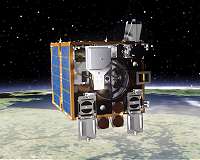
An experimental spacecraft built by the Surrey Satellite Technology Limited (SSTL) subsidiary of Airbus and deployed in June 2018 aims to demonstrate innovative debris-removal technologies during the coming months. The spacecraft, named RemoveDEBRIS, was released from the International Space Station and will carry out its Airbus designed-and-built active debris removal experiments, or ADR, in the following nine months.
RemoveDEBRIS, managed by the University of Surrey Space Centre, will test four separate ADR strategies: a capture net, vision-based navigation, a harpoon and a deorbiting drag sail (SSC).
Nicolas Chamussy, the head of Airbus Space Systems said: "We have spent many years developing innovative systems to be at the forefront of tackling this growing problem, and to contribute the United Nations' Sustainable Development Goals for future generations.
We will continue to work closely with teams across the world to make our expertise available to help solve this issue."
The RemoveDEBRIS satellite's capture net experiment, developed by Airbus in Bremen, Germany, will see a small cubesat deployed from the main mission craft. After moving away, the cubesat will be targeted by the net and captured at a distance of approximately seven metres. The pair will then naturally deorbit, burning up upon re-entry in the atmosphere. This experiment will take place in September.
The mission's vision-based navigation (VBN) system, comes from Airbus in Toulouse, France and will be tested in October. Relying on 2D cameras and 3D LIDAR (light detection and ranging) technology, RemoveDEBRIS will precisely track a cubesat deployed from the main spacecraft – observing the target's rotation and movement away.
At the same time, the cubesat will transmit its true position to the main spacecraft, enabling the VBN system's performance to be measured. This will serve as a precursor to developing orbital rendezvous techniques with space debris. Once the VBN system testing is completed, the cubesat's trajectory will allow it to deorbit naturally.
