
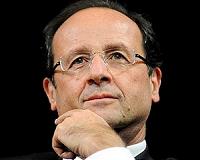
Forging a global climate pact hinges on rich nations making firm financial commitments, French President Francois Hollande said Monday, warning of "risks of failure" for a year-end Paris conference.
"There will be no agreement… if there is no firm commitment on finance" for developing nations, he said as ministers and diplomats from 57 countries met elsewhere in the French capital to discuss exactly this issue.
The November 30-December 11 UN conference is tasked with sealing a universal deal to roll back the threat of climate change.
But without an accord on finance, "countries will refuse, emerging economies… and they are right," the president told journalists.
Finance is a major stumbling block in the fraught, years-long UN effort to conclude a pact committing all the world's nations to curbing climate-altering greenhouse gases.
The overarching goal is to limit average global warming to two degrees Celsius (3.6 degrees Fahrenheit) over pre-Industrial Revolution levels — the threshold at which scientists say we can still avoid worst-case-scenario climate effects.
Hollande addressed a press conference as foreign and environment ministers and senior officials concluded two days of talks on the finance question.
Funding is the key to help developing countries shift to greener energy, adapt to a climate-altered world and deal with the loss and damages they will suffer from rising seas, droughts, storms and other impacts.
Poor and developing nations, among the most threatened by global warming, are insisting rich counterparts show how they intend to meet a promise made in 2009 of $100 billion (90 billion euros) in climate finance annually from 2020.
At the end of the informal ministerial meeting, French Foreign Minister Laurent Fabius insisted the $100 billion commitment "must be respected."
In a bid to "give credibility to the process," he said, France and Peru, which hosted last year's climate conference, had asked the Organisation for Economic Cooperation and Development (OECD), a coordinating forum on economic matters, to provide clarity on how the figure will be fleshed out.
"It will tell us what is being done on climate by governments… by multilateral banks, by the private sector," the minister said.
"This will naturally allow us to determine a trend, to see whether we are on track vis-a-vis the target of $100 billion in 2020, or if there are additional efforts to be made."
The ministerial talks were not part of official negotiations for the highly-anticipated agreement, but are meant to inject momentum into the troubled UN process.
– Everything turns on finance –
On Friday, a five-day round of official text-drafting negotiations closed in Bonn with diplomats expressing frustration at their own lagging progress.
They will meet again in the former West German capital from October 19 to 23 to work on the unwieldy blueprint — currently an 83-page laundry list of contradicting country options for dealing with the problem.
"Everything will turn on the question of finance," Hollande said Monday, and warned that the way things stand: "There are risks of failure."
Janos Pasztor, assistant UN secretary general on climate, agreed at a conference elsewhere in Paris that: "Financing is absolutely key."
"$100 billion is not that much when we want to change the whole world into a no-carbon future," he said. "For that we need trillions" — and the bulk will have to come from the private sector.
Observers are hopeful that a string of climate-themed meetings in the coming weeks and months will boost the process, bogged down in fights over procedure and ideology.
A meeting of the UN General Assembly later this month, said Hollande, would be a "major" step on the road to Paris, as would a joint International Monetary Fund-World Bank meeting in Lima in October.
And he announced he would travel to China in November, to "launch an appeal for the success of the climate conference" with President Xi Jinping.
"If we don't conclude an agreement… it's not hundreds of thousands of refugees that we'll have to deal with in the next 20 or 30 years, it's millions," Hollande said as Europe struggled to deal with an influx of migrants, mainly from war-torn Syria.
Paris climate talks our last chance, say Pacific leaders
Port Moresby (AFP) Sept 7, 2015 –
Pacific leaders said Monday that upcoming climate talks in Paris are the last chance for the world to reach an agreement that can save their vulnerable island nations.
The leaders of the six smallest members of the Pacific Islands Forum (PIF) said they were among the hardest hit by climate change, and a binding agreement at the so-called COP21 talks in December was crucial.
Meeting before the annual PIF summit formally opens in Port Moresby on Tuesday, representatives from the Cook Islands, Kiribati, the Marshall Islands, Nauru, Palau and Tuvalu issued a strongly worded plea to the rest of the world to act.
"This is our last chance to reach an outcome that must reverse the global warming pathway to ensure the future survival and existence of our nations, people and culture," they said.
They said their islands, some of which are less than a metre (three feet) above sea level, were already suffering the impact of climate change.
The COP21 talks will seek a binding deal to take effect in 2020 that will commit 195 nations to emissions cuts.
The island leaders said commitments in Paris should include limiting average global warming to 1.5 degrees Celsius (2.7 degrees Fahrenheit) over pre-Industrial Revolution levels.
They also said any ambitious climate change plan should include a moratorium on new coal mines.
"We cannot afford to lock in any further fossil fuel emissions," the leaders said.
Territories such as Tuvalu and Tokelau fear their nations will become unlivable as rising waters erode coastlines and ruin crops, while Kiribati has purchased a large block of land in Fiji in case its entire population needs to relocate.
The full 15-nation PIF is expected to echo the sentiments of the small island nations during this week's summit.
