
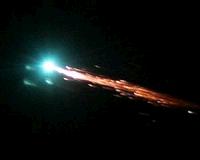
China's defunct Tiangong-1 space lab is expected to make a fiery re-entry into the earth's atmosphere in the coming days and disintegrate in what Chinese authorities promise will be a "splendid" show.
The re-entry of the nearly eight-tonne Tiangong-1 poses little threat, officials and experts say, and much larger objects have plunged back to Earth — at the end of their missions or in accidents — without causing any serious damage on the surface.
Here are the biggest spacecraft that disintegrated as they crashed back to earth:
Mir – 2001
Launched in 1986, the Mir station was once a proud symbol of Soviet success in space, despite a series of high-profile accidents and technical problems.
But Russian authorities, strapped for cash after the collapse of the Soviet Union, chose to abandon the orbiting outpost in the late 1990s and devote their resources to the International Space Station.
The massive 140-tonne station was brought down by the Russian space agency over the Pacific Ocean between New Zealand and Chile, and its burning debris was seen streaking across the sky over Fiji.
Salyut 7 – 1991
Salyut 7, launched in 1982, was the last orbiting laboratory under the Soviet Union's Salyut programme.
When the Mir space station was launched in 1986, Soviet space authorities boosted Salyut 7 to a higher orbit and abandoned it there.
It was supposed to stay in orbit until 1994, but an unexpected increase in drag by the earth's atmosphere caused it to hurtle down in 1991.
The 40-tonne station broke up on re-entry and the parts that survived scattered over Argentina.
Skylab – 1979
Skylab was the first American space station, launched by NASA in 1973, and was crewed until 1974.
There were proposals to refurbish it later in the decade, but the lab's orbit began to decay and NASA had to prepare for its re-entry into the Earth's atmosphere with only partial control over where it would come down.
The 85-tonne Skylab's eventual descent over Australia was a worldwide media event, with some newspapers offering thousands of dollars to people who recovered parts of the station that landed.
Columbia – 2003
The disintegration of large spacecraft has not always been without tragedy.
In 2003, NASA's space shuttle Columbia broke apart during its re-entry into the atmosphere at the end of the STS-107 mission, killing all seven astronauts on board.
Columbia's left wing was damaged by a piece of debris during launch, leaving the shuttle unable to withstand the extreme temperatures generated by re-entry, and causing it to break apart.
The flaming debris from the 80-tonne craft was caught streaking across the sky over the southern US by local TV stations, with tens of thousands of the doomed shuttle's parts scattered over Texas and Louisiana.
Point Nemo, Earth's watery graveyard for spacecraft
Paris (AFP) March 30, 2018 –
One place China's Earth-bound and out-of-control spacelab, Tiangong-1, will probably not hit on Sunday is the forlorn spot in the southern Pacific Ocean where it was supposed to crash.
Officially called an "ocean point of inaccessibility," this watery graveyard for titanium fuel tanks and other high-tech space debris is better known to space junkies as Point Nemo, in honour of Jules Verne's fictional submarine captain.
Point Nemo is further from land than any other dot on the globe: 2,688 kilometres (about 1,450 miles) from the Pitcairn Islands to the north, one of the Easter Islands to the northwest, and Maher Island — part of Antarctica — to the South.
"Its most attractive feature for controlled re-entries is that nobody is living there," said Stijn Lemmens, a space debris expert at the European Space Agency in Darmstadt, Germany.
"Coincidentally, it is also biologically not very diverse. So it gets used as a dumping ground — 'space graveyard' would be a more polite term — mainly for cargo spacecraft," he told AFP.
Some 250 to 300 spacecraft — which have mostly burned up as they carved a path through Earth's atmosphere — have been laid to rest there, he said.
By far the largest object descending from the heavens to splash down at Point Nemo, in 2001, was Russia's MIR space lab, which weighed 120 tonnes.
"It is routinely used nowadays by the (Russian) Progress capsules, which go back-and-forth to the International Space Station (ISS)," said Lemmens.
The massive, 420-tonne ISS also has a rendezvous with destiny at Point Nemo, in 2024.
In future, most spacecraft will be "designed for demise" with materials that melt at lower temperatures, making them far less likely to survive re-entry and hit Earth's surface.
Both NASA and the ESA, for example, are switching from titanium to alumium in the manufacture of fuel tanks.
China hoisted Tiangong-1, it's first manned space lab, into space in 2011. It was slated for a controlled re-entry but ground engineers lost control in March 2016 of the eight-tonne craft in March 2016, which is when it began its descent toward a fiery end.
The chances of anyone getting hit by debris from Tiangong-1 are vanishingly small, less than one in 12 trillion, according to the ESA.
"Nemo," by the way, means "no one" in Latin.
