
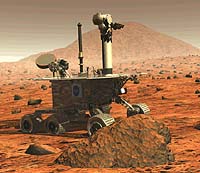
Cornell University has been selected by NASA to provide the scientific instruments and lead the science team for the next mission to the surface of Mars.
The space agency announced today that a rover mission will be launched on June 4, 2003, and the spacecraft will land on Mars on Jan. 20, 2004.
The mission, which will carry a large roving vehicle to the surface of Mars, was chosen by Edward Weiler, NASA associate administrator for space science, after an intensive two-month study of the two competing candidates, the rover and a scientific orbiter.
Steven Squyres, Cornell professor of astronomy who will be the principal investigator on the Athena science cargo to be carried by the rover, says the Cornell package of instruments was chosen because of its promise of "outstanding science." The scientific purpose of the mission, he notes, "is pure in situ exploration of the surface of Mars."
Also on Squyres' large international science team will be Jim Bell, assistant professor of astronomy at Cornell, who will have responsibility for the rover's Pancam panoramic camera system. Pancam will reveal the terrain around the rover and will be used by the science team to select the most promising rock and soil targets for intensive study.
The spacecraft carrying the rover will use the same concept for landing on the Martian surface as employed by the Pathfinder spacecraft in its 1997 mission: A parachute will slow the spacecraft down, and airbags will inflate to cushion the landing.
The new rover, however, will be considerably larger than the Pathfinder's Sojourner rover, weighing close to 130 kilograms (or about 250 pounds) and having a range of up to 100 meters (about 100 yards) per Martian day.
The rover's science package will consist of six scientific instruments, which Squyres says will allow it to act as "a robotic field geologist." The instruments, besides the Pancam, inlcude:
