
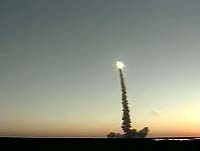
The Space Shuttle Discovery blasted off from the Kennedy Space Center here on Thursday to pick up the International Space Station's first crew and drop off an Italian module, Leonardo.
The shuttle got an early start for its latest journey, rising into the cloudless sky at 6:42 am (1142 GMT). Discovery is set to rendezvous with the space station at an altitude of 311 kilometers (190 miles) late Friday, and three of its seven crew members will not be returning to Earth with the shuttle at the end of the mission.
Russian Yuri Usachev and US astronauts Susan Helms and James Voss are to stay behind for a five-month tour on the space station.
They replace the current crew members, US astronaut William Shepherd and Russians Yuri Gidzenko and Sergei Krikalev, who have been on board for four months.
The space station's second crew "will conduct a number of experiments that will further our knowledge of the space environment and its impact on the human body," said Mike Hawes, deputy associate administrator for the space station at NASA's headquarters.
Leonardo is one of three pressurized cargo-carrying modules built by the Italian Space Agency. The "moving van" module will shuttle equipment for experiments performed in the space station's US laboratory module Destiny, or the future European laboratory Columbus, between Earth and the station.
Leonardo and, in the future, its sister modules Raffaello and Donatello, will be brought back to Earth laden with the resulting experiments.
A cylinder measuring 6.4 meters (21 feet) in length and 4.6 meters (15 feet) across, Leonardo can carry some 9.1 tonnes of freight in 16 cases.
On this mission, it will carry six cases to Destiny.
During the 12-day mission, astronauts will conduct two spacewalks to install equipment to the outside of the US laboratory. They will also prepare a system for attaching a future Canadian arm.
Discovery's mission marks the eighth voyage to the 112-tonne International Space Station, which will take another five years to complete, at cost estimates of between 60 billion and 96 billion dollars.
The space station stretches some 51 meters (168.3 feet) in length and 72 meters (237.6 feet) in width and is 27 meters (89.1 feet) high. Its principle elements are the Destiny lab, the Russian modules Zaria and Zvezda and immense solar panels that stretch out like wings.
A further 39 missions by the shuttle program and by Russian rockets are planned before the 16-nation International Space Station project is complete.
Once it is up and running, the International Space Station's laboratory will continue to be used until 2013.
All rights reserved. ¿ 2001 Agence France-Presse. All information displayed on this section (dispatches, photographs, logos) are protected by intellectual property rights owned by Agence France-Presse. As a consequence, you may not copy, reproduce, modify, transmit, publish, display or in any way commercially exploit any of the content of this section without the prior written consent of
