
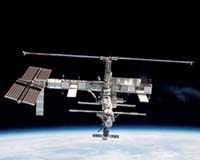
A new method developed by Draper Laboratory for performing large angle rotations of the International Space Station (ISS) was flight tested successfully on November 5. By scheduling a series of commands to the ISS Control Moment Gyro (CMG) attitude controller, the ISS was maneuvered through a pre-planned trajectory, referred to as the Zero Propellant Maneuver (ZPM). The ZPM is accomplished using the current Station controllers and effectors without modification to flight software.
Prior to development of the ZPM method, large angle attitude re-orientation of the ISS was performed using thrusters as the CMGs do not have enough capacity to control along a standard trajectory. The ZPM has the benefit of saving valuable propellant by not using the station thrusters, and also avoids the solar array plume impingement and contamination issues associated with thruster firings.
According to Draper's Dr. Naz Bedrossian, who led the development of the ZPM, "The pre-planned trajectory is optimized to take advantage of naturally occurring environmental torques in order to maintain CMG capacity within operational margins while performing the re-orientation. This is similar to the way a sail boat would tack against the wind."
This flight demonstration of the ZPM method successfully completed a 90 degree rotation using only three CMGs. The maneuver used 80 combined attitude and rate commands spaced 90 seconds apart, taking a total time of approximately 2 hours. An equivalent maneuver using the Station thrusters would have taken less time but would have consumed costly propellant.
