
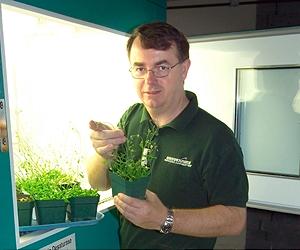
In theory, plants could be the ultimate "green" factories, engineered to pump out the kinds of raw materials we now obtain from petroleum-based chemicals. But in reality, getting plants to accumulate high levels of desired products has been an elusive goal.
Now, in a first step toward achieving industrial-scale green production, scientists from the U.S. Department of Energy's (DOE) Brookhaven National Laboratory and collaborators at Dow AgroSciences report engineering a plant that produces industrially relevant levels of compounds that could potentially be used to make plastics. The research is reported online in Plant Physiology, and will appear in print in the December issue.
"We've engineered a new metabolic pathway in plants for producing a kind of fatty acid that could be used as a source of precursors to chemical building blocks for making plastics such as polyethylene," said Brookhaven biochemist John Shanklin, who led the research. "The raw materials for most precursors currently come from petroleum or coal-derived synthetic gas.
Our new way of providing a feedstock sourced from fatty acids in plant seeds would be renewable and sustainable indefinitely. Additional technology to efficiently convert the plant fatty acids into chemical building blocks is needed, but our research shows that high levels of the appropriate feedstock can be made in plants."
