
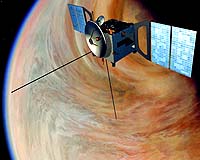
A European space probe went into orbit around Venus on Tuesday, mission controllers said, after a 400-million-kilometre (250-million-mile trip) to peer into its toxic atmosphere and swirling clouds.
The Venus Express probe slowed down and locked into Venus's gravitational field at 10:08 am (0808 GMT), said controllers at the European Space Agency's Space Operations Centre in Darmstadt, Germany.
"A fantastic moment. We are finally around Venus," said the Canadian head of the project, Don McCoy, in a video broadcast from the headquarters of the European Space Agency (ESA) in Paris.
Venus Express — the first European probe to Venus — is due to spend 486 Earth days — or just two Venusian days — studying its hot, dense atmosphere, which is choked with 96-percent carbon dioxide.
At some 120 million kilometres from Earth, the craft fired its main engine for 51 minutes to help reduce its spped of 29,000 kilometres per hour and slip into Venus's gravitational pull.
It will first spend nine days ranging between 400 and 350,000 kilometres (250 and 217,000 miles) from the planet before going into regular orbit.
Venus Express — a virtual copy of the Mars Express now orbiting the Red Planet — carries seven powerful instruments to probe the thick swirl of clouds covering Venus, testing for geological information and evidence of volcanic activity.
It is also due to examine the 400 kilometre-per-hour winds that rage in the skies 60 kilometres above the planet's surface, and whose causes are unknown.
Venus is Earth's closest neighbour and regarded by astronomers as its twin. The two are similar sizes and both composed of rocks. But Venus is much hotter, with ground temperatures reaching 460 degrees Celsius (860 Fahrenheit).
The 220-million-euro (264-million-dollar) Venus Express was built by the European satellite company EADS Astrium and launched on November 9, 2005, by from the Baikonur base in Kazakhstan.
The mission would help to "better understand, better predict, better manage the Earth and its endowment for the benefits of all citizens of the world", said ESA Director general Jean-Jacques Dordain.
