
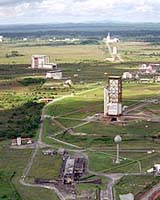
Meeting in Paris earlier this month, the European Space Agency (ESA) Council agreed to free up funds for its Ariane 5 launcher ¿ putting it on the right flight path for future space exploration under a broader European flag.
Vital to Europe's bold space programme plans is a new co-operation agreement with Russia, which sees Soyuz experts and technology teamed up with Arianespace at the Guiana Space Centre to carry out joint launch activities from 2006 onwards.
The unanimous decision by ESA's 15 member states to share expertise with the Russians consolidates Europe's place in space. It also gives Europeans better launching capacity and wider access to this exciting new frontier, a statement read.
ESA is confident that the agreement will reinforce Europe's launcher sector while allowing Arianespace to work towards a new generation of globally competitive rocket technology.
Aim high Jean-Jacques Dordain, ESA's director-general, was upbeat about Europe's space sector. "We have a launcher which is highly appreciated worldwide and the preparation of future developments is now a reality," he said after the Council's decision on 4 February.
"In 2006, [when] Soyuz lifts off from Europe's spaceport in Kourou (French Guiana) we will have reached with our Russian partner another important milestone for Europe in space.
"Once more, when Europe's future is on the line, the member states are able to find the energy to overcome the difficulties, coming up with the right solutions at the right time," he added.
Built to (b)last
Ariane 5 is designed to meet the challenges of a modern and competitive space programme: the ability to launch larger satellites, increasing use of low orbits for servicing the International Space Station and the need to reduce costs while maintaining reliability.
Since its first operational flight in December 1999 ¿ Ariane 5 has proved highly reliable and economic, and has been used to launch satellites for communications, Earth observation and scientific research into geostationary orbits and Sun-synchronous orbits. ESA built a special launch site at Europe's spaceport in Kourou, as well as facilities to make the solid boosters needed to launch Ariane 5, the most powerful launcher in the Ariane family.
Co-operation that counts
This time last year, hundreds of top-level representatives from the European Union, ESA and the Russia space agency, Rosaviakosmos, were meeting in Moscow to draw up a road map for enhancing joint space research within the context of the EU's Sixth Framework Programme (FP6).
At that meeting Research Commissioner Philippe Busquin spoke of Europe's openness towards research collaboration leading to better knowledge and application of space.
"We are not building an EU science and technology fortress. Our interest is to build a European Research Area¿ and co-operation with Russian scientists and industry on space matters is of undeniable mutual interest," he said after the event.
ESA's decision this month is a welcome addition to joint space efforts between Russia and the EU. Close to 100 space-related projects have been implemented jointly in over three decades of collaboration.
Finding new common space
