
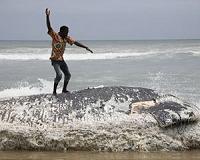
What do you do with a rare blue whale weighing up to 180 tons that has died and is threatening to explode its stinking innards all over your town?
That is the unusual quandary the 600 bemused residents of a Canadian fishing town have been wrestling with since the 25-meter-long (80 feet) creature washed up last week on the shores of Trout River, Newfoundland.
The growing global interest has even spawned the aptly named hasthewhaleexplodedyet.com website to track the fate of the rotting carcass, which has ballooned to more than twice its normal girth as it fills dangerously with methane gas.
Town manager Emily Butler told AFP on Tuesday that "there is a concern it can explode" and the close-knit community in the North Atlantic — which now reeks of dead whale — lacked the resources to safely dispose of the carcass.
Federal officials initially balked at getting involved, saying the whale should be left to naturally decompose and warning residents not to drag it out to sea because it could become a hazard to navigation.
Then the Fisheries Minister Gail Shea announced that scientists from the Royal Ontario Museum in Toronto would head to Trout River next week to recover the carcass.
A second blue whale that washed up in nearby Rocky Harbour will also be retrieved, the minister said.
– 'Once in a lifetime' –
If the dead mammal has become a smelly nuisance and an unwanted attraction for the townsfolk, scientists see it as a rare — if unfortunate — opportunity.
"Blue whales are one of the largest animals to have ever lived on Earth," Shea said.
"There are fewer than 250 mature (adult) blue whales in the Northwest Atlantic population. The chance to preserve, study and examine up to two skeletons is a once-in-a-lifetime opportunity and of great scientific and educational value for Canadians."
The massive animals are two of nine endangered blue whales that are believed to have died in heavy ice off the southwest coast of Newfoundland several weeks ago.
And while there has been quiet sniggering about the prospect of an animal blowing up, experts and conservationists say the loss of five percent of the population as "extremely unfortunate."
"It is unprecedented to have this number of blue whales perish at once in a single area," said Canada's fisheries department.
The whale that washed up on the rocks just below Trout River's boardwalk on April 25 has attracted crowds of fascinated onlookers and officials seeking to assess the unusual danger.
Newspaper headlines shouted: "There She Blows," "This Dead Whale Could Explode at Any Minute," "Canadian Town Patiently Waits for Washed Up Blue Whale Carcass to Explode" and "Has the Whale Exploded Yet?"
But the actual risk of the whale combusting is small — it would have to be punctured — and the likelihood of injuries is low.
"It's all overblown," the Royal Ontario Museum's Mark Engstrom said, adding that the carcass if left alone would eventually deflate on its own.
– 'Stink to high heaven' –
Engstrom and his team are scheduled to fly to easternmost Canada next week to take apart the whale using "very large knives to remove the skin and the blubber… until we're left with the bones, which we'll bring back in sections."
"It's going to stink to high heaven," he said.
The researchers will take frozen tissue samples for analysis.
Back at the museum, Engstrom said it will take up to two years to painstakingly clean the bones.
Thereafter the skeleton and tissue samples will be stored in the museum's research collection, which will be accessible to researchers worldwide, and maybe someday put on display.
"It's the largest animal that has ever lived so a lot of the issues (in this project) are a matter of scale," he said. "It's a huge undertaking."
"You can prepare a mouse (for preservation) in about half an hour. A whale will obviously take a lot longer."
It will be the museum's first blue whale specimen, and only the third in Canada.
Meanwhile the vigil at the carcass goes on.
A tweet Friday uploaded to hasthewhaleexplodedyet.com by a local journalist read: "Sorry to disappoint those who may be anticipating exploding whale. Likely won't happen. Bloating decreasing."
