
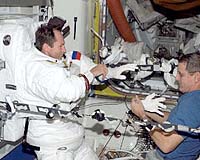
A former astronaut says protecting humans from high-level radiation, as well as bone and muscle loss, pose the greatest challenges in getting to Mars.
Former NASA Payload Specialist James Pawelczyk told an Experimental Biology 2006 meeting Tuesday in San Francisco every cell in one's body could experience a high energy event with heavy metal ions during the 13- to 30-month Mars round trip.
Pawelczyk, now an associate professor of kinesiology and physiology at Pennsylvania State University, said the major challenge involved in reaching Mars "isn't the engineering work to design the spacecraft, because most of those tasks are identified and being addressed."
He said the most important questions concern the human body and will present unprecedented challenges in space life medicine and physiology.
"Given the current time frame for a Mars trip in 2020 to 2025, the scientists who will do the research to address these issues are the high school students of today," he said.
Pawelczyk spoke to an audience of high school students and science teachers during an American Physiological Society Education program held during Experimental Biology 2006.
