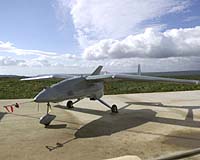
Galileo Avionica's Simulation and UAV Business unit is developing a new air-launched high-performance mini-unmanned air vehicle, named Locusta (Locust).
Initially intended to be launched from the company's Mirach 100/5 target, it will act as a secondary target to be used against new generation surface-to-air air defence missile systems, in training and tests conditions were a direct hit is required.
The 2 meter long, 20 kg heavy jet-powered mini-UAV presents a cylindrical airframe made of composite materials and aerodynamics control surfaces, including a deployable wing, tails empennages and front canard surfaces.
Thanks to a miniaturised navigation and asset control package- including an auto-pilot, altitude and speed sensors, plus navigation system- when the Locusta is released by its mother platform, it will deploy wings and follow a pre-programmed flight plan, which can be monitored by a ground station through a communication link, also used to give mission termination commands to the mini-UAV.
Two Locusta system can be carried and released by a Mirach 100/5 target drone. Payloads planned to be carried by the mini-drone include radar, optical and infrared signature enhancing systems.
Initial early-prototype captive-flights were performed last autumn, and follow-on flying testing is expected for this year.