
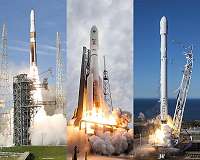
According to a new market intelligence report by BIS Research titled "Global Space Propulsion System Market – Analysis and Forecast (2018-2023)", the global space propulsion system market is expected to reach $10.40 billion by 2023 and witness a high growth rate of 13.06%, during the forecast period, 2018-2023, in terms of value.
The growth of the market can be attributed to the significant increase in the manufacturing of both satellites and launch vehicles. Significant investment in the development of cost-effective and efficient propulsion systems is another prominent factor leveraging the growth of the market.
For instance, in August 2018, NASA awarded contracts to six companies including SSL, Blue Origin, and Aerojet Rocketdyne, among others, with an aggregate worth $44 million, to develop advanced propulsion system.
Other than the private companies, space agencies are also focused on developing more efficient and less toxic space propulsion systems. Indian Space Research Organization (ISRO), an India-based space agency, showed exceptional performance with the development of indigenous cryogenic rocket propulsion system and electric satellite propulsion system.
Similarly, Japan Aerospace Exploration Agency (JAXA), in collaboration with IHI Corporation, is developing a propulsion system using Liquefied Natural Gas (LNG) with liquid oxygen.
Moreover, National Aeronautics and Space Administration (NASA), in alliance with several private companies, is developing advanced propulsion systems for deep space missions. Such developments are expected to provide an impetus to the space propulsion system market over the coming years.
According to Vaishali Sharma, Research Analyst at BIS Research, "In the past two decades, there has been tremendous advancement in propulsion systems, especially in engines or propellant, for safe, reliable, and affordable access to space.
"Numerous space organizations and companies have been developing efficient propulsion systems, which can increase the capability of solid and liquid propulsion systems and enhance the technology readiness level of new systems, such as air-breathing propulsion system and unconventional propulsion system. These developments in propulsion systems reduce the production and operational costs and enhance performance capabilities."
The market report on space propulsion system provides a detailed analysis of the recent and future trends influencing the market along with technological developments in the market. It also includes the competitive analysis of the leading players in the industry, including corporate overview, financial summary, and SWOT analysis. The overall market has been segmented on the basis of end user, application, type, and region.
Commercial, government, and military are covered as parts of the end-user segmentation of the market in the present report, wherein the report includes satellite and launch vehicles as the application areas of space propulsion systems. In addition to this, chemical, electric, and hybrid propulsion systems are the sub-segments of the global space propulsion system market by satellite type; and solid, liquid, and hybrid propulsion systems are the sub-segments of the global space propulsion system market by launch vehicle type.
The advancements in space technology have led the key manufacturers to build space propulsion systems for future applications such as deep space missions. IHI Corporation, Lockheed Martin Corporation, Mitsubishi Heavy Industries, Ltd., Northrop Grumman Corporation, Airbus SAS, Safran, OHB System AG, Bradford, Thales Group, Aerojet Rocketdyne, Moog Inc., Bradford, Space Exploration Technologies Corp. (SpaceX), Ariane Group GmbH, Blue Origin, Phase Four, and Accion Systems Inc. are some of the leading producers that use advanced technologies in space propulsion systems.
