
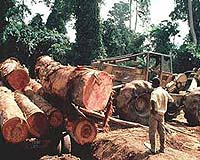
Greenpeace on Monday condemned Spain's growing "war timber" trade with conflict-divided Ivory Coast and urged Madrid to suspend all import of tropical wood from the west African country.
"Greenpeace publicly denounces the connection of Spain's tropical timber industry with ecological damage and funding the armed conflict in Ivory Coast," the Spanish wing of the international environmental organisation said.
The environmental watchdog body, which is represented in 40 countries, took Spanish government figures to show in a statement that import of timber from Ivory Coast had increased in quantity by 23.79 percent and value by 30.35 percent in the first half of 2004, compared with the previous year.
The amount of imported wood grew by a 17.5 percent in the first six months of 2005 as compared with January-June 2004. For the latter period the total was 35,148 tonnes, worth 25 million euros.
Ivory Coast has been divided between the rebel-held north and the government south since a foiled coup against President Laurent Gbagbo in September 2002 led to full-scale civil war, then an uneasy truce monitored by French and UN peacekeeping troops.
"The situation recalls the plundering endured by (Ivory Coast's volatile neighbours) Liberia and Sierra Leone between the end of the 1990s and 2003, when 'warlord' Charles Taylor financed conflicts in the region by getting his hands on the diamond and timber trades," Greenpeace said.
Taylor's activities as then president of Liberia after a brutal civil war, before rebels and international pressure ousted him, led the UN Security Council to impose an international embargo on Liberian forestry products. This, Greenpeace noted in its statement, "is still in force today."
"The suspension of timber imports from Ivory Coast is indispensable to cut finance for conflict in the country and to avoid and even worse social and economic deterioration with an eye to the post-conflict perspective," Greenpeace said.
Ivory Coast, once the prosperous economic hub of a whole region of mainly former French colonies, is still the world's leading cocoa producer.
