
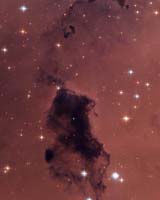
New images by the Hubble Space Telescope have captured dense blobs of dust and gas in a relatively nearby star-forming region of the Milky Way. The cosmic dust bunnies contain elements responsible for the formation of stars in the galaxy and elsewhere throughout the universe.
The opaque, dark knots of gas and dust are called Bok globules – after Dutch astronomer Bart Bok, who first proposed their existence in the 1940s. They are absorbing light in the center of a nearby nebula and star-forming region called NGC 281.
Bok hypothesized that giant molecular clouds, on the order of hundreds of light-years in size, can become perturbed and form small pockets of highly concentrated dust and gas. The pockets become gravitationally bound and accumulate dust and gas from the surrounding area. If they can capture enough mass, they could create stars in their cores – although not all Bok globules form stars. Some dissipate before they can collapse – which could be what is happening to the globules seen in NGC 281.
Near the globules are bright blue stars, members of the young open cluster IC 1590. The cluster is made up of a few hundred stars. The cluster's core, off the image towards the top, is a tight grouping of extremely hot, massive stars with an immense stellar wind. The stars emit visible and ultraviolet light that energizes the surrounding hydrogen gas in NGC 281. The gas then becomes super heated in a process called ionization, and it glows pink in the image.
The Bok globules in NGC 281 are located very close to the center of the IC 1590 cluster. Hubble's high-resolution observations show the jagged structure of the dust clouds, as if they are being stripped apart from the outside. The heavy fracturing of the globules may appear serene, but in fact it suggests the harsh, violent environment created by the nearby massive stars.
The globules are silhouetted against the luminous pink hydrogen gas of the emission nebula, creating a stark visual contrast. The dust knots are opaque in visual light. Conversely, the nebulous gas surrounding the globules is transparent and allows light from background stars and even background galaxies to shine through.
Hubble took the images in October 2005 with its Advanced Camera for Surveys. The orbiting telescope's science team combined the hydrogen-emission image, which clearly shows the outline of the dark globules, with others taken in red, blue and green light to help establish the true color of the stars in the field.
NGC 281 is located nearly 9,500 light-years away in the direction of the constellation Cassiopeia.
