
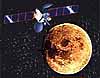
Hughes Space has achieved a space first with the successful insertion of a wayward satellite into geo-stationary orbit via two lunar flybys.
HGS-1 was launched last Christmas Day. Because of a malfunctioning launch vehicle, it was left in an unusable, highly elliptical orbit. Insurers declared it a total loss for its original purposes, which was for communications and television services in Asia. Hughes Global Services, Inc., (HGS) obtained title in April to the fully functional satellite, an HS 601HP model built by Hughes Space and Communications Company (HSC).
Hughes orbital engineers devised a novel mission to salvage the
satellite, using lunar gravity to improve the resulting orbit once the
satellite returned to Earth. That flyby, in mid-May, was the first
commercial mission to the moon. Encouraged by the precision of that
mission, Hughes performed a second lunar rendezvous this month to
further improve the orbit.
The second mission concluded today. At 11:29 a.m. PDT, Hughes
satellite controllers fired the on-board motor for 12 minutes, which
slowed the spacecraft enough to enter a circular orbit 22,300 miles
(36,000 km) above the equator. HGS-1 will be "parked" in a dormant
state over the Pacific until Hughes finds customers for it.
When HGS obtained title to the satellite, it agreed to try to find
revenue-producing uses for the satellite and to share profits with the
insurers. "This is a real opportunity for someone to kick-start or
augment their business with an in-orbit satellite, at less cost and
time than it would take to contract and build their own satellite,"
said Ronald V. Swanson, HGS president. Even though HGS' primary
business is packaging satellite communications services for
governmental entities, it is actively seeking interest in the entire
satellite as well.
HGS-1 made its first swing around the moon May 13. On May 16, as
the satellite approached Earth, controllers slowed it down by firing
the on-board rocket motor. This put the satellite into a 15-day orbit
around Earth with an apogee — the farthest distance from Earth — of
about 303,000 miles (488,000 km). The moon is about 250,000 miles
away (402,000 km).
On June 1, controllers nudged the satellite into position for a
second lunar flyby. It passed the moon again on June 6, at a distance
of nearly 21,300 miles (34,300 km) from the surface, which is about 52
times farther than the initial lunar encounter of 3,883 miles (6,200
km). A small firing of the rocket motor June 11 reoriented the
satellite for its final orbit around Earth.
Last Sunday at 9:15 a.m. PDT, controllers fired the motor for 46
minutes, and again for two minutes at 10:50 a.m. These burns slowed
HGS-1 into a 46-hour orbit ranging in altitude from 22,300 miles
(36,000 km) to 51,000 miles (82,000 km). Tuesday, controllers
performed a 28-minute burn at 7:29 a.m. PDT, putting it into a nearly
circular 28-hour orbit. Today's burn captured it in a 24-hour,
geosynchronous orbit, so that it will orbit Earth at the same speed
that the planet rotates. It will stay at roughly the same spot above
Earth, but will drift a few degrees north and south of the equator
every day.
"The lunar recovery mission team did an outstanding job. Everything has gone just as predicted," Swanson said. "It really validates the viability of this technique for future missions."
