
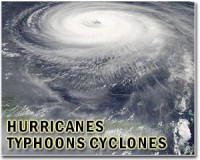
Meteorologists believe they've found a new way to track the intensity and trajectory of hurricanes by measuring the atmospheric gravity waves emanating from the storms' centers.
Atmospheric gravity waves are propelled in spirals outward from the center of large storm systems.
Scientists at the University of Miami and the NOAA's Hurricane Research Division were able to analyze waves detected by a NOAA aircraft and research buoy. They published their analysis in the journal Geophysical Research Letters.
"These very subtle waves can sometimes be seen in satellite images," lead study author David Nolan, professor of atmospheric sciences at Miami, said in a news release. "We were able to measure them in aircraft data and surface instruments."
Computer models suggest the strength of the waves is related to the maximum wind speeds at the hurricane's center. The findings suggest relatively inexpensive instruments could monitor the strength and positioning of hurricanes by measuring the atmospheric waves, just as seismographs monitor tremors and earthquakes.
"The waves cause very weak upward and downward motions, which are recorded by the NOAA P3 as it flies through the storm," said Jun Zhang, a scientist with the Hurricane Research Division. "But we were surprised at how clearly the waves could be detected at the surface."
Hurricanes are monitored extensively by weather satellites, but space-based instruments can't always measure the hurricane's center.
"These waves can reveal processes occurring in the eyewall of a hurricane that are obscured from the view of satellites by thick clouds," said Nolan. "Any additional measurements, even if they provide similar information as satellites, can lead to better forecasts."
NASA spots Eastern Pacific season's earliest first tropical storm in satellite era
The first tropical storm in the Eastern Pacific Ocean has formed west of Costa Rica as NASA-NOAA's Suomi NPP Satellite passed overhead. Tropical Storm Adrian's formation has already made a mark in hurricane history.
Although Eastern Pacific hurricane season doesn't start officially until May 15, it's just a marker. We've already seen the first tropical storm in the Atlantic Ocean form in e … read more
