
The Spanish Fireball Network is an interdisciplinary project of three
mediterranian universities (Valencia, Castello and Barcelona) together
with the Research Catalan Foundation (FCR).
We have analysed the fireballs produced by the entry of meteoroids in the Earth atmosphere using photographic and video techniques. We explain below our key arguments as to our belief that these ice ball objects cannot be of a non-terrestrial nautre.
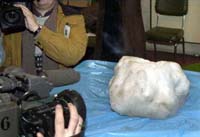
Our knowledge on the composition of these ice balls is increasing. Over the past two weeks the Chemistry Department of the University of Valencia has obtained a detailed analysis of one reliable ice ball that fell near Valencia.
From this and other analysis obtained by the Spanish Higher Council for Scientific Research (CSIC) we can say that the objects are composed of water ice with some small quantities of common salts. In all cases the isotopic composition corresponds closely to the natural isotopic mix of terrestrial atmospheric water.
In these conditions, we must remark here that no other solar system objects (comets either) have a similar composition.
Comets are bodies formed by ice-dust dark aggregates as suggested long time ago Fred L. Whipple. We know that cometary ice is a very complex mixture of dust particles with ices of water, methane, ammonia,
etc. In any case all cometary components have important isotopic
anomalies.
Velocities of Solar System objects at their encounter with the Earth
atmosphere are necessary within a limit, as a consequence of encounter
geometries and the relative velocity between the bodies.
The lowest impact velocity of a meteoroid with our atmosphere is 11,2 km/s (considering only Earth's gravity). The upper limit is close to 73 km/s (considering a 30.3 km/s velocity plus a 42.5 km/s velocity to an object following a parabolic orbit).
During the entry the preheating is intense and the surface temperature of meteoroid rises rapidly. Surface temperatures as low as 500 K and shock pressures can disrupt with rapidity a homogeneous ice body.
The mass loss during the atmospheric ablation can reach the 100% meteoroid mass, especially in low-density bodies as reported. In any case they must result in an impressive fireball seen – on occassion – by a lot of people.
No one reports any such events that can eb connected to the ice-ball falls. Our Photographic Network also does not report any significative increase in fireball activity during the past month.
As a consequence of high velocity entry and hard atmospheric ablation
the fall of a 5kg-ice body in the Earth surface implies a huge entering
body. But we cannot explain either the fall of a single 5 kg object.
The reason is that in low density materials, such as water ice, it can beexpected that the original object will disintegrate into a multitude of fragments, falling in an impressive rain, as has been reported in many real meteorite events.
Finally we can calculate the impact expected velocity into the Earth
surface of 1-10kg mass bodies. Assuming free fall after deceleration
this velocity would be close to 100 m/s. We think clearly that such
velocity is higher that the estimated in the majority of reported fall
events.
All previous arguments lead to the conclusion that the reported falls
of ice objects in Spain and, recently, in Italy are originated by an
atmospheric unknown phenomenon or, more probably as in other
occasions, due to natural ice formation on the fuselage or ejection of
on-board water in aeroplanes. In any case a cosmic origin is highly
improbable.
