
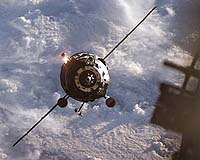
The International Space Station's Expedition 13 crew welcomed the Russian Progress 22 automated resupply ship this past week and prepared for the arrival of space shuttle Discovery.
Progress 22 brought 2.5 tons of fresh produce, other foodstuffs, food, fuel and supplies to the station on June 26. After the cargo ship was fully connected with station systems, flight controllers in Moscow completed a routine thruster test, and Vinogradov removed its Kurs automated rendezvous hardware.
Discovery's launch is now scheduled for 2:38 p.m. Eastern Time on Tuesday. The orbiter's STS-121 mission will increase the station's crew to three members for the first time since 2003, when ESA astronaut Thomas Reiter joins the current crew members: Pavel Vinogradov, the commander, and Jeff Williams, the flight engineer.
STS-121's agenda includes at least two spacewalks, so in order to prepare for those events, the station crew flushed cooling loops in the Quest airlock and U.S. spacesuits, configured airlock systems and tools and reviewed robotic arm procedures.
Vinogradov and Williams checked out a ship-to-ship communications system that will be used for conversations with Discovery's crew during rendezvous. They also disconnected the station's common cabin air assembly heat exchanger. That device will be returned to Earth aboard Discovery along with other equipment in the Italian-built Leonardo Multipurpose Logistics Module. Discovery will use Leonardo to bring about 5,000 pounds of supplies to the station.
The crew also completed a mid-mission session of the renal stone experiment by collecting urine samples and logging all of the food and drinks consumed over a three-day period. Each crewmember is taking either potassium citrate, a drug found to be useful in preventing kidney-stone formation on Earth, or a placebo. Crews in space are at risk for kidney stones because of their loss of bone density.
