
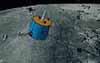
There is a high probability that water ice exists at both the north and south poles of the Moon, according to initial scientific data returned by NASA's Lunar Prospector.
The Discovery Program mission also has produced the first
operational gravity map of the entire lunar surface, which should
serve as a fundamental reference for all future lunar exploration
missions, project scientists announced today at NASA's Ames
Research Center, Moffett Field, CA.
Just two months after the launch of the cylindrical
spacecraft, mission scientists have solid evidence of the
existence of lunar water ice, including estimates of its volume,
location and distribution. "We are elated at the performance of
the spacecraft and its scientific payload, as well as the
resulting quality and magnitude of information about the Moon that
we already have been able to extract," said Dr. Alan Binder, Lunar
Prospector Principal Investigator from the Lunar Research
Institute, Gilroy, CA.
The presence of water ice at both lunar poles is strongly
indicated by data from the spacecraft's neutron spectrometer
instrument, according to mission scientists. Graphs of data ratios
from the neutron spectrometer "reveal distinctive 3.4 percent and
2.2 percent dips in the relevant curves over the northern and
southern polar regions, respectively," Binder said. "This is the
kind of data 'signature' one would expect to find if water ice is
present."
However, the Moon's water ice is not concentrated in polar
ice sheets, mission scientists cautioned. "While the evidence of
water ice is quite strong, the water 'signal' itself is relatively
weak," said Dr. William Feldman, co-investigator and spectrometer
specialist at the Department of Energy's Los Alamos National
Laboratory, NM. "Our data are consistent with the presence of
water ice in very low concentrations across a significant number
of craters." Using models based on other Lunar Prospector data,
Binder and Feldman predict that water ice is confined to the polar
regions and exists at only a 0.3 percent to 1 percent mixing ratio
in combination with the Moon's rocky soil, or regolith.
How much lunar water ice has been detected? Assuming a water
ice depth of about a foot and a half (.5 meters) — the depth to
which the neutron spectrometer's signal can penetrate — Binder
and Feldman estimate that the data are equivalent to an overall
range of 11 million to 330 million tons (10-300 million metric
tons) of lunar water ice, depending upon the assumptions of the
model used. This quantity is dispersed over 3,600 to 18,000
square miles (10,000-50,000 square kilometers) of water ice-
bearing deposits across the northern pole, and an additional 1,800
to 7,200 square miles (5,000-20,000 square kilometers) across the
southern polar region. Furthermore, twice as much of the water
ice mixture was detected by Lunar Prospector at the Moon's north
pole as at the south.
Dr. Jim Arnold of the University of California at San Diego
previously has estimated that the most water ice that could
conceivably be present on the Moon as a result of meteoritic and
cometary impacts and other processes is 11 billion to 110 billion
tons. The amount of lunar regolith that could have been "gardened"
by all impacts in the past 2 billion years extends to a depth of
about 6.5 feet (2 meters), he found. On that basis, Lunar
Prospector's estimate of water ice would have to be increased by a
factor of up to four, to the range of 44 million to 1.3 billion
tons (40 million to 1.2 billion metric tons). In actuality,
Binder and Feldman caution that, due to the inadequacy of existing
lunar models, their current estimates "could be off by a factor of
ten in either direction."
The earlier joint Defense Department-NASA Clementine mission
to the Moon used a radar-based technique that detected ice
deposits in permanently shadowed regions of the lunar south pole.
It is not possible to directly compare the results from Lunar
Prospector to Clementine because of their fundamentally different
sensors, measurement "footprints," and analysis techniques. However,
members of the Clementine science team concluded that its radar
signal detected from 110 million to 1.1 billion tons (100 million
to 1 billion metric tons) of water ice, over an upper area limit
of 5,500 square miles (15,500 square kilometers) of south pole terrain.
There are various ways to estimate the economic potential of
the detected lunar water ice as a supporting resource for future
human exploration of the Moon. One way is to estimate the cost of
transporting that same volume of water ice from Earth to orbit.
Currently, it costs about $10,000 to put one pound of material
into orbit. NASA is conducting technology research with the goal
of reducing that figure by a factor of 10, to only $1,000 per
pound. Using an estimate of 33 million tons from the lower range
detected by Lunar Prospector, it would cost $60 trillion to
transport this volume of water to space at that rate, with unknown
additional cost of transport to the Moon's surface.
From another perspective, a typical person consumes an
estimated 100 gallons of water per day for drinking, food
preparation, bathing and washing. At that rate, the same estimate
of 33 million tons of water (7.2 billion gallons) could support a
community of 1,000 two-person households for well over a century
on the lunar surface, without recycling.
"This finding by Lunar Prospector is primarily of scientific
interest at this time, with implications for the rate and
importance of cometary impacts in the history and evolution of the
Solar System," said Dr. Wesley Huntress, NASA Associate
Administrator for Space Science. "A cost-effective method to mine
the water crystals from within this large volume of soil would
have to be developed if it were to become a real resource for
drinking water or as the basic components of rocket fuel to
support any future human explorers."
Before the Lunar Prospector mission, historical tracking data
from various NASA Lunar Orbiter and Apollo missions had provided
evidence that the lunar gravity field is not uniform. Mass
concentrations caused by lava which filled the Moon's huge craters
are known to be the cause of the anomalies. However, precise maps
of lunar mass concentrations covering the moon's equatorial
nearside region were the only ones available.
Lunar Prospector has dramatically improved this situation,
according to co-investigator Dr. Alex Konopliv of NASA's Jet
Propulsion Laboratory, Pasadena, CA. Telemetry data from Lunar
Prospector has been analyzed to produce a full gravity map of both
the near and far side of the moon. Konopliv also has identified
two new mass concentrations on the Moon's nearside that will be
used to enhance geophysical modeling of the lunar interior. This
work has produced the first-ever complete engineering-quality
gravity map of the moon, a key to the operational safety and
fuel-efficiency of future lunar missions.
"This spacecraft has performed beyond all reasonable
expectations," said NASA's Lunar Prospector mission manager Scott
Hubbard of Ames. "The findings announced today are just the tip
of the iceberg compared to the wealth of information forthcoming
in the months and years ahead."
Lunar Prospector is scheduled to continue its current primary
data gathering mission at an altitude of 62 miles (100 kilometers)
for a period of ten more months. At that time, the spacecraft
will be put into an orbit as low as six miles (10 kilometers) so
that its suite of science instruments can collect data at much
finer resolution in support of more detailed scientific studies.
In addition, surface composition and structure information
developed from data returned by the spacecraft's Gamma Ray
Spectrometer instrument will be a crucial aspect of additional
analysis of the polar water ice finding over the coming months.
The third launch in NASA's Discovery Program of lower cost,
highly focused planetary science missions, Lunar Prospector is
being implemented for NASA by Lockheed Martin, Sunnyvale, CA, with
mission management by NASA Ames. The total cost to NASA of the
mission is $63 million.
