
Going out and about in freezing conditions could become safer thanks to fundamental research at the University of Edinburgh into how we slip on ice.
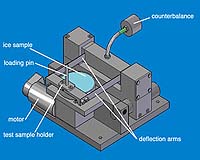
Using funding from the Engineering and Physical Sciences Research Council (EPSRC) researchers at Edinburgh have built a device, known as a Tribometer, to measure the friction generated as different materials, such as rubber or metal, slip across a sample of ice. The Tribometer is designed to investigate how factors such as temperature, object weight, material composition and velocity affect friction.
The team then examines the ice sample using a state-of-the-art Low Temperature Scanning Electron Microscope (LTSEM). This detail of observation has never been done before and allows the team to investigate what is happening to the ice at scales from several millimetres to as small as nanometres.
Obvious products that could benefit from the research include car tyres and shoes. The project has already attracted the involvement of both Ford and Jaguar. Sports engineers could use the data to design better skis and ice skates, except in this case they would be looking to engineer surfaces that do slip more easily. In addition, the Tribometer could also be used to study the efficiency of 'gritting' agents.
Dr Jane Blackford, who heads the team, and was also a consultant to the UK Olympic Curling Team who won a gold medal in the 2002 Winter Olympics in Salt Lake City, says, "Although people have studied ice friction before, there are still many open questions. We are aiming to fill in those gaps and understand why friction varies under different conditions."
The team has already found that the temperature of the ice plays a large role in how it responds when an object begins to slip.
Dr Blackford says, "I hope the data from this project will provide a bedrock of solid information that manufacturers can use to design more effective, slip-resistant surfaces, tailored to the specific ice conditions in which they will be used."
At its simplest level, once an object begins to slip, friction between it and the icy surface creates heat. This melts some of the ice, providing a lubricant that allows the object to slide more. The Edinburgh team have discovered that at 'high' ice temperatures, for example ¿5 degrees C, friction creates ripples in the ice surfaces because some ice has melted and then refrozen.
Whereas, at lower ice temperatures, for example ¿23 degrees C, friction causes the ice surface to fracture. Understanding such differences could prove crucial when designing surfaces that come into contact with ice. Dr Jane Blackford works in the School of Engineering and Electronics and the Centre for Materials Science and Engineering at the University of Edinburgh.
Jane Blackford was a consultant to the UK Olympic Curling Team who won a gold medal in the 2002 Winter Olympics in Salt Lake City. She built a device to characterize the players' abilities when 'sweeping' the ice to change the direction and speed of the 'stone'. The success inspired Channel 4's Scrapheap Challenge team to devise the new sport of 'car curling'. Jane Blackford helped to judge the one and only staging of this sport.
The tyre-ice friction project is co-supervised by Dr V Koutsos and involves PhD student Daniel Higgins, who is funded by an EPSRC CASE Studentship. The LTSEM work is done in collaboration with Dr Chris Jeffree who is director of the college's electron microscopy facility. Goodyear provided the rubber samples for the study.
Ice is a tricky substance to work with in a scientific way. It melts easily and, even below 0 degrees C when it is 'solid', its surface changes through the capture or release of atoms (known respectively as condensation and sublimation). The researchers circumnavigate these pitfalls by working quickly with their ice samples.
How the Tribometer works
