
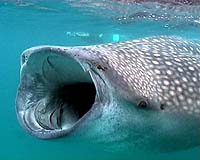
Researchers plan to employ a new computer algorithm normally used by astronomers to recognize star patterns to identify individual whale sharks in an effort to protect them.
Whale sharks, the largest fish on Earth, are at risk of extinction, with less than 350 confirmed sightings since the mid-1980s. Although they are found around the world in tropical and warm seas (except in the Mediterranean), whale sharks are uncommon and researchers think they have been threatened by unsustainable fishing practices in some regions. They are listed as "vulnerable to extinction" by the World Conservation Union.
A major hurdle in the conservation and management of whale sharks has been the absence of accurate data on their population biology and movements. Photographic identification has been attempted before, but the task had been considered impractical because of the complexity of the spotted patterns. Now, identifying individual spot pattern "fingerprints," by automating the pattern-matching process, will help fill that gap.
Marine biologist Brad Norman and information architect Jason Holmberg, both of the organization ECOCEAN, worked with astrophysicist Zaven Arzoumanian of the Universities Space Research Association and NASA's Goddard Space Flight Center to develop the computer software. They discovered that a pattern-matching algorithm developed by astronomers to locate celestial objects could be used to identify individual whale sharks.
"Photo-identification has been used for the flukes of whales and also animals such as leopards, zebras, cheetahs, and giraffes," Norman said. "Some computer-aided matching has been attempted, but I am not aware of anything as high-tech or ground-breaking as this."
Volunteers will track whale sharks this summer in the Ningaloo Marine Park in Western Australia to tag individuals photographically and use the software to identify them and chart their movements.
"The implications of this computer-aided identification technique and web-based photo library for management and conservation of whale sharks may be profound," Norman said. "The Library will enable us to gain better insight into the numbers of whale sharks that are surviving in the wild." With additional information about the population size, structure, and movements of whale sharks, it will be possible to know how to direct conservation efforts and whether marine reserves are effectively protecting them.
