
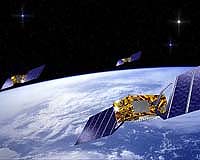
India and the European Union Wednesday signed an agreement sealing New Delhi's participation in the satellite navigation system called Galileo which aims to rival the United States' global positioning system.
The agreement was signed by G. Madavan Nair, chief scientist of the Indian Space Research Organisation, and the EU's representative to India Francisco da Camara Gomes, on the sidelines of the sixth India-EU summit.
"We have signed the agreement…the equity will be decided according to the extent of our participation," Nair told a press conference.
The signing was witnessed by Britain's Prime Minister Tony Blair, whose country holds the six-month rotating EU presidency, European Commission President Jose Manuel Barroso and Javier Solana, the high representative for common foreign and security policy.
India announced its intention to participate in the Galileo project in 2003 but formally sealed its intent only on Wednesday.
The EU says the globe-girdling satellites will enable the development of new services in areas such as transport, the environment, agriculture and fisheries that are eventually expected to cover the running costs of the system.
Galileo is slated to be operational by 2008 as a rival to the US Global Positioning System and to be able to track everything from aircraft to cars through 30 satellites. Both India and the EU said the system would only be for civilian use.
It has been speculated that India had promised to pick up a 350-million-dollar stake in the estimated 3.5 billion euro (4.37 billion dollar) project.
India sees itself as a rising space power and has launched a number of satellites, most of them through a partnership with the European Space Agency.
The other major contributor to the project is China, which has agreed to sign seven contracts with the EU to participate in Galileo and has committed itself to a 241-million-dollar investment in the project.
