
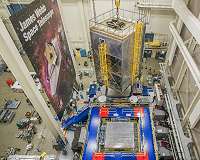
For the acoustic test, the telescope was wrapped in a clean tent, and engineers and technicians pushed it through a large pair of insulated steel doors nearly a foot thick into the Acoustic Test Chamber. In the chamber the telescope was exposed to the earsplitting noise and resulting vibration of launch.
A new vibration test system also known as a shaker table, was built specifically for testing the Webb. The Webb was mounted on the shaker table and experienced the simulated forces the telescope will feel during the launch by vibrating it from 5 to 100 times per second. The test ensures a spacecraft like Webb can withstand the vibrations that occur as a result of the ride into space on a rocket.
This spring, after other environmental tests are completed, the Webb telescope will be shipped to NASA's Johnson Space Center in Houston, Texas, for end-to-end optical testing in a vacuum at its extremely cold operating temperatures, before it goes to Northrop Grumman Aerospace Systems in Redondo Beach, California, for final assembly and testing prior to launch.
By performing these tests, scientists and engineers can ensure that the spacecraft and all of its instruments will endure the launch and maintain functionality when it is launched from French Guiana in 2018.
Another reason to flip the off switch: light pollution
For the 11th year running, cities worldwide will turn their lights off Saturday to mark Earth Hour in a global call to action on climate change.
But the moment of darkness should also serve as a reminder, activists say, of another problem that gets far less attention: light pollution.
More than 80 percent of humanity lives under skies saturated with artificial light, scientists recently … read more
