
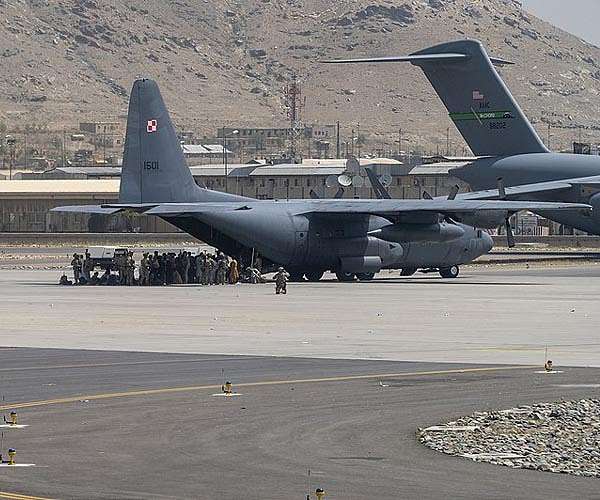
The 13 US military troops killed in the bombing attack on Kabul airport Thursday amounted to the worst single-day loss for the Pentagon in Afghanistan since 2011.
The US Defense Department said 13 were killed after two suicide bombers deployed by the Afghanistan branch of the Islamic State group detonated their bombs by a key gate into the airport and at a nearby hotel used for staging evacuees.
The initial toll was 12, which increased when an additional service member died from his wounds.
Ten of those killed and several wounded were US Marines, Marine Corps spokesman Major Jim Stenger said in a statement.
– Helicopter missions –
The two-decade war has cost 1,909 US military lives in combat. The heaviest losses came on August 6, 2011, when insurgents shot down a Chinook transport on a nighttime mission in Wardak province southwest of Kabul.
Thirty US American service members, including 22 Navy SEALs special operations troops, were killed in the crash, as well as eight Afghans and a US military dog.
Prior to that, the worst single-day toll also involved a helicopter. On June 28, 2005, three Navy SEALs were killed in a firefight after being flown in to the mountains of the eastern Kunar province.
A helicopter loaded with reinforcements that was sent to help one SEAL still alive on the ground and recover the bodies of the three was shot down, killing 16 on board.
– Firefights –
Other major losses include a firefight between scores of Taliban fighters and US troops in Wanat in Nurestan province in July 2008, which saw nine US troops killed.
Fifteen months later, in October 2009, eight Americans died in a similar battle with hundreds of Taliban fighters in Kamdesh, also in Nurestan province.
– Perceived allies –
The war has also seen high tolls from attacks by perceived allies on the Americans.
On April 27, 2011 eight members of the US Air Force and one US civilian were shot dead in Kabul airport by an Afghan pilot.
And on December 30, 2009, a "triple-agent" whom US intelligence thought was on their side killed seven CIA officers and contractors, along with two others, at a CIA facility in eastern Afghanistan known as Camp Chapman.
Up to 20 dead in Kabul airport blasts as airlift deadline looms
Kabul (AFP) Aug 26, 2021 –
Two powerful explosions outside Kabul airport killed as many as 20 people Thursday, just hours after Western nations warned of an imminent terror threat and thousands of people gathered hoping for a flight out of Taliban-controlled Afghanistan.
The blasts came as the August 31 deadline looms for the United States to withdraw its troops, and for it and other Western countries to end a massive airlift that has already evacuated nearly 100,000 people.
The airport is the only part of the country under foreign control following the Taliban's return to power on August 15, and huge crowds have massed in the hope of being evacuated.
Zabihullah Mujahid, the Taliban's main spokesman, told AFP that "between 13 and 20" people were killed and 52 wounded in the twin blasts, while Kabul hospitals reported six dead and up to 90 wounded.
The Pentagon said "a number" of US troops died in what spokesman John Kirby called a complex attack.
US President Joe Biden had earlier cited an "acute" terrorist threat from the regional chapter of the Islamic State jihadist group.
The Taliban condemned the blasts, saying they were in an area under US military control.
"The Islamic Emirate strongly condemns the bombing targeting civilians at Kabul airport," said a statement released by Mujahid on Twitter.
– 'Total panic' –
Graphic video shared on social media showed bodies lying semi-submerged in a canal adjacent to the airport, where thousands have gathered since the Taliban takeover of August 15 hoping for a flight out.
"When people heard the (first) explosion there was total panic," a man name Milad told AFP.
"The Taliban then started firing in the air to disperse the crowd. I saw a man rushing with an injured baby in his hands."
The US government and its allies had raised the alarm earlier in the day with a series of advisories warning their citizens to avoid the airport.
No specifics were given, but Belgium's Prime Minister Alexander De Croo referred to a threat from suicide bombers.
London also issued a warning to its citizens, saying "if you can leave Afghanistan safely by other means, you should do so immediately".
– 'Truly heartbreaking' –
After the blasts, images posted on social media showed men ferrying injured people to safety in wheelbarrows.
In another picture, a boy was seen clutching the arm of a man whose clothes were soaked in blood.
In the confusion after the first blast Thursday, one man said he dropped the documents he hoped would help him board a flight with his wife and three children.
"I will never ever want to go (to the airport) again. Death to America, its evacuation and visas," he said.
More than 95,000 Afghans and foreigners have fled Afghanistan via the US-led airlift since the hardline Taliban movement took control of the country.
Despite security warnings, huge crowds of people desperate to flee the Taliban continued to throng the airport, their bid for a way out becoming increasingly anxious ahead of next Tuesday's deadline set by Biden to end evacuations and withdraw troops.
Biden has not budged on the hard deadline — even as some foreign nations warned they would be forced to leave at-risk Afghans behind.
Shortly after the blasts the White House said Biden was being briefed on the attack, delaying a planned meeting with Israel's visiting prime minister and cancelling another event.
NATO Secretary General Jens Stoltenberg said allied forces should continue to evacuate as many vulnerable people as they can from Kabul despite what he branded a "horrific terrorist attack".
But several Western allies have already wrapped up their airlift operations including Canada, whose government said it was "truly heartbreaking" to leave behind those who wanted to be rescued.
Germany's defence minister said Berlin has pulled out all its soldiers, while Chancellor Angela Merkel condemned the "heinous" attack.
– Islamic State threat –
In recent years, the Islamic State's Afghanistan-Pakistan chapter has been responsible for some of the deadliest attacks in those countries.
It has massacred civilians at mosques, shrines, public squares and even hospitals.
The group has especially targeted Muslims from sects it considers heretical, including Shiites.
But while IS and the Taliban are both hardline Sunni Islamist militants, they are rivals and oppose each other.
The Taliban have promised a softer brand of rule from their first stint in power, which ended in 2001 when the United States invaded because they gave sanctuary to Al-Qaeda.
But many Afghans fear a repeat of the Taliban's brutal interpretation of sharia law, as well as violent retribution for working with foreign militaries, Western missions or the previous US-backed government.
There are particular concerns for women, who were largely banned from education and employment and could only leave the house with a male chaperone during the group's 1996-2001 rule.
Some of the Afghans massed outside the airport have foreign passports, visas or eligibility to travel, but most do not.
