
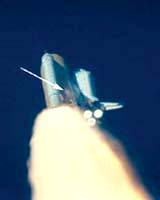
Insulating foam that fell from the external
fuel tank and struck the space shuttle Columbia on takeoff is again at the
center of the probe into the tragedy, data out Tuesday show.
An independent investigating commission showed to reporters a four-second
video made by NASA of Columbia's January 16 takeoff during which debris is
seen striking shuttle's left wing near its landing wheel well.
Columbia burned up on reentry into the earth's atmosphere on February 1
after superheated gasses entered a breach in the orbiter's skin in the area
struck by the foam.
The shuttle was just 16 minutes from landing when it disintegrated over
Texas, killing all seven astronauts on board.
NASA officials at first discounted the frozen foam insulation as a cause
leading to the disaster.
Investigators are now looking into whether the front of the wing, which
faces extremely high temperatures on reentry, might have been damaged, causing
a rupture in the vessel's protective outer layer that led to its burning up on
reentry.
In the video, "a piece of foam comes down impacting the leading edge," said
Sheila Widnall, a member of the investigating panel.
Admiral Harold Gehman, who is leading the probe, said that other
photographs indicate more debris.
"From other camera angles, most photo analysts think they were three pieces
of debris — whether or not two are foam and one is ice, or all have ice and
foam, we don't know," he said.
To date, a total of 28,286 pieces of the shuttle have been collected and
are being assembled in a hanger at the Kennedy Space Center in Cape Canaveral,
Florida. Of those, 25,404 have been identified, Gehman said.
However just laying the debris on the floor "is not enough," Gehman said.
"Heat testing is necessary."
Meanwhile a NASA engineer whose e-mail messages seemed to predict failures
leading to the loss of the shuttle said he only meant to speculate about
worse-case scenarios.
"I wanted to make sure that everybody could be as ready as possible for any
eventuality," engineer Robert Daugherty told reporters.
"The e-mail was intended to spark discussion to ensure there were such
plans and I believe they did just that."
NASA engineers worried about possible damage from the falling insulating
foam, but space agency officials dismissed the concerns, stating there was no
need for a space walk to assess any damage which they suggested could have
caused further harm.
E-mail messages show mission specialists were nevertheless concerned
throughout the orbiter's mission. Only recently did NASA release the exchange
of messages, causing chagrin among NASA's friends and foes alike.
"Honestly, I was very surprised by the attention my writing received,"
Daugherty said during the telephone press conference.
Daugherty wrote to a NASA official: "You should seriously consider the
possibility of the (landing) gear not deploying at all if there is a
substantial breach of the wheel well."
At some point the wheel "could fail and send debris everywhere," he wrote,
adding that sending out astronauts to look at the damage "has more pros than
cons."
"Can't imagine that an astronaut would cause MORE damage than he is going
out to look for," he wrote.
Astronauts may have tried to take control of Columbia
