
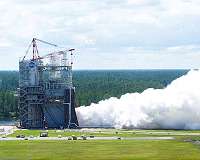
Many innovators have proposed a variety of concepts that might propel a launch vehicle from Earth to orbit. However, only two basic types of rocket engines have survived the test of fire: Solid propellant and liquid propellant rockets. There are still a few who believe hybrids are the answer to achieving orbital speeds with meaningful payloads.
However, none of the liquid/solid contraptions have proven worthy of large investments. Alas, the space launch vehicle community remains limited to a selection of pressure-fed solid motors and pump-fed liquid engines for use on the main stages of space launch systems.
Variations of this theme have been tried, but have failed. For example, pressure-fed liquid rockets have been studied and tested, but have fallen short of the competitive range. A variety of propellants have been proposed, but only a very limited number of combinations have survived.
For example, most of the current liquid-propellant launch stages use either LOX-kerosene or LOX-hydrogen combinations. The latter of these represents the highest energy density combination that has proven to be practical.
Unfortunately, the rocket propulsion research community has not been able to achieve any technologically transformative breakthroughs in the last several decades. The present propellants have been studied, tested and used in operational launch systems over the past half-century.
Rocketdyne's F-1 rocket engine, developed in the late 1950s, was used as the first-stage of the Saturn V. This engine retains the title of the most powerful single-combustion-chamber, liquid-propellant rocket.
Over the past 50 years rocket developers have improved the technology and performance of these propulsive devices, but not by orders of magnitude. Each improvement step has been beneficial, but a breakthrough is needed to make space accessible for all to use.
Even today, after 60 years of space flight research, development and testing, only very wealthy individuals, large corporations and government agencies have access to space.
Humans must leave Earth to explore and thrive. A lack of new propulsion technology is the barrier to further space colonization and popular utilization. There remains a great deal of work to tear down this barrier.
India shows off space prowess with launch of mega-rocket
India Monday successfully launched its most powerful home-produced rocket, another milestone for its indigenous space programme which one day hopes to put a human into orbit.
The 43-metre (140-foot) rocket hurtled into a clear sky at 5:28 pm (1158 GMT) from the southern island of Sriharikota, one of two sites used by the Indian Space Research Organisation (ISRO) to launch satellites.
Sci … read more
