
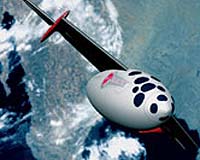
British entrepreneur Richard Branson's company Virgin Galactic reported is talking with insurance giant Lloyd's about underwriting its private spaceflight ventures. Lloyd's acknowledged the talks on its Web site on Tuesday, but made not direct comment about the possibility.
Virgin is hoping to launch the first space tourist flights into sub-orbital space sometime in 2008. The company has proposed to launch the flights from a new spaceport site in New Mexico, and Lloyd's appears to be among the insurers in talks about providing cover.
Bruno Ritchie, director of the aerospace division at Hiscox Global Markets, said in a statement issued by Lloyd's the first thing the insurance market will have to determine is if the risk is an aviation or space risk.
Ritchie said insurance is likely to be sought for the hull value of the spacecraft, with the price of cover dependent on the safety and reliability of the venture established through its testing phase, which probably will require between 50 and 100 test flights. He said third- party liability coverage also might be required to protect Virgin against claims from people living nearby the launch site – in case of pollution or a crash occurring over their homes.
Any potential passengers who have expressed an interest in paying about $200,000 each for the spaceflights would require personal accident coverage as well.
Ritchie said passengers initially might have to travel at their own risk, because insurers would be reluctant to provide personal accident coverage until Virgin Galactic could establish a safety record for the flights.
Construction of the spacecraft is due to begin next month, based on designs developed by Burt Rutan's company, Scaled Composites, of Mojave, Calif., for its SpaceShipOne, which won the $10 million Ansari X Prize for the world's first private spaceflight in October 2004. Virgin Galactic has contracted with Scaled Composites to build its new space vehicle.
The flights as envisioned would provide passengers about 20 minutes in space, with five minutes in a weightless state. The first flights would launch once a week, and eventually would increase to once a day.
